
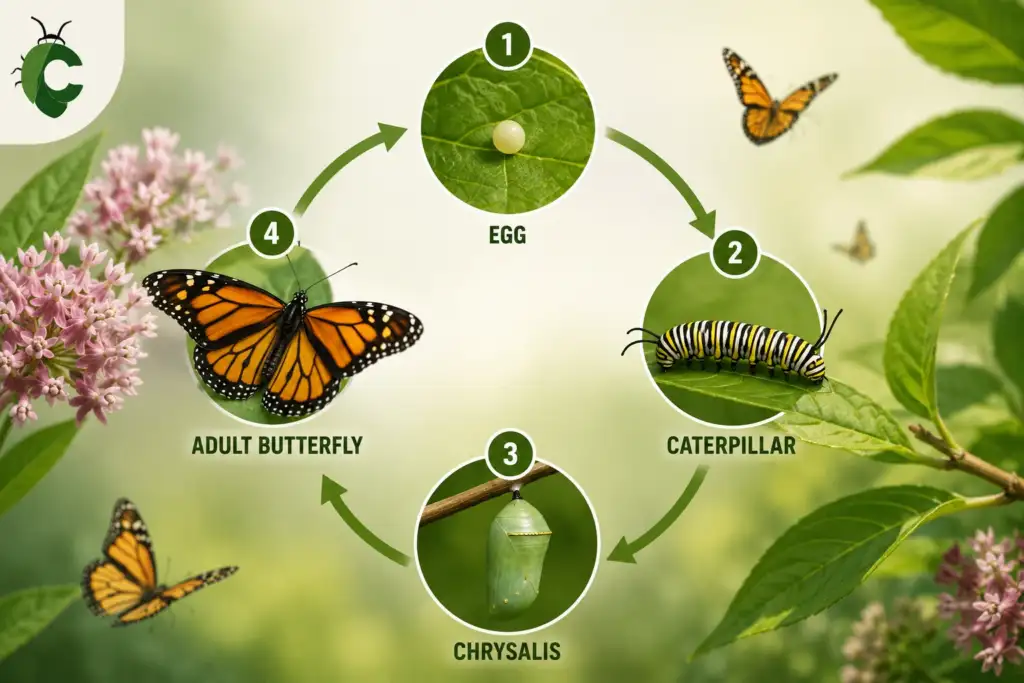
- The butterfly life cycle contains four stages: egg, larva, pupa, and adult.
- Monarch butterflies complete the cycle in 25 to 40 summer days.
- Caterpillars pass through five instars before forming a chrysalis.
- The pupa stage lasts 8 to 15 days and involves complete tissue reconstruction.
- Adult monarchs live 2 to 6 weeks; migratory generations survive 8 to 9 months.
The butterfly life cycle consists of four distinct stages: egg, larva (caterpillar), pupa (chrysalis), and adult. Monarch butterflies (Danaus plexippus) complete this entire sequence in approximately 30 days under ideal summer conditions of 75 to 85 degrees Fahrenheit. Each stage performs a specific biological function that ensures species survival across North American breeding ranges. Many online resources conflate cocoons with chrysalises or provide vague timelines that confuse classroom instruction and home observation. This guide delivers exact stage durations, field-specific terminology, and visually scannable tables you can use for lesson planning or nature observation. Complete metamorphosis in butterflies represents one of the most accessible entry points into insect biology for educators, parents, and students.
What Is Complete Metamorphosis?
Holometabolous insects undergo four discrete morphological stages: egg, larva, pupa, and adult. Hemimetabolous insects such as grasshoppers and true bugs experience gradual nymph development and lack the pupal stage entirely. The butterfly life cycle represents one of the most visually accessible examples of complete metamorphosis in North American fauna. Ecdysone and juvenile hormones regulate every transition between stages through precise endocrine signaling. Research from the University of Minnesota Department of Entomology identifies ecdysone as the primary hormone that triggers each stage transition by initiating cuticle shedding and cellular reorganization. Juvenile hormone levels determine whether a molt produces another larval instar or initiates pupation. Butterflies demonstrate this hormonal cascade with exceptional clarity because each stage occupies a separate ecological niche and physical form.
Stage 1: Egg and the Science of Butterfly Egg Hatching
Female butterflies deposit eggs singly or in clusters on specific host plants that caterpillars consume after hatching. Monarch eggs measure roughly 1.2 millimeters in height and appear ridged with a pointed apex. Incubation lasts 3 to 5 days for monarchs at temperatures between 75 and 85 degrees Fahrenheit but extends to 10 days in cooler conditions below 65 degrees Fahrenheit. Larvae chew through the egg shell immediately after emergence and consume the chorion for initial protein.
In July 2024, monarch egg clusters observed on Asclepias tuberosa in a home garden in Minnesota hatched within a documented 4-day window. Daily morning checks revealed no visible larvae on day 1, minute first instar caterpillars present on day 4, and empty chorions attached to leaf undersides by day 5. The eggs displayed vertical ridges and a pale cream color that darkened to a charcoal head cap approximately 24 hours before butterfly egg hatching commenced.
How to Identify Butterfly Eggs on Leaves
Garden observers locate monarch eggs by checking leaf undersides of milkweed plants. Butterfly eggs appear as round or oval shapes with vertical ridges and a slightly pointed apex. Do not touch or relocate wild butterfly eggs. Oils from human skin disrupt embryonic respiration through the egg chorion and reduce hatch rates.
Stage 2: Larval Instar Stages and Caterpillar Development
Caterpillars pass through 5 distinct instars and shed their cuticle after each growth phase through ecdysis. Monarch caterpillars increase their body mass by approximately 2,700 times between the first instar and the fifth instar. The larval stage lasts 10 to 14 days for monarchs in summer temperatures between 75 and 85 degrees Fahrenheit. Fifth instar caterpillars enter a wandering phase 24 to 36 hours before pupation during which they cease feeding and search for a pupation site.
What Do Caterpillars Eat Before Chrysalis Formation?
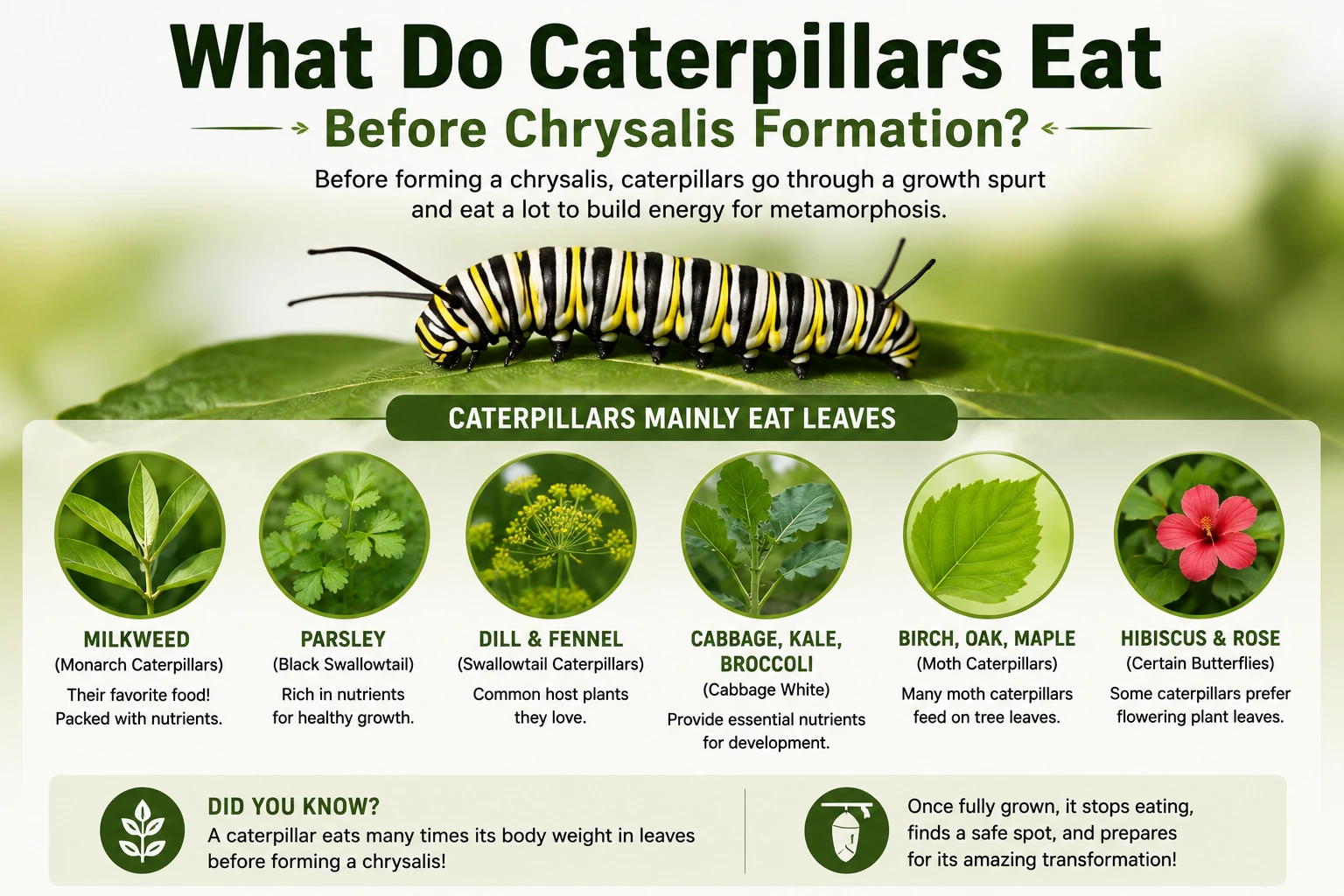
Monarch larvae consume only milkweed species (Asclepias). Cardenolide toxins from milkweed accumulate in larval tissue and provide adult chemical defense against predators. Cuticle apolysis separates the old cuticle from the epidermis before each ecdysis event. Hemolymph circulation changes dramatically during instar transitions as the open circulatory system temporarily halts to accommodate cuticle shedding.
The following table outlines larval instar stages for monarch caterpillars under typical summer conditions.
| Instar | Duration | Approximate Length |
| 1st | 1 to 2 days | 2 to 6 mm |
| 2nd | 1 to 2 days | 6 to 9 mm |
| 3rd | 1 to 2 days | 10 to 14 mm |
| 4th | 1 to 2 days | 13 to 25 mm |
| 5th | 3 to 5 days | 25 to 45 mm |
First instar monarch caterpillars emerge at roughly 2 millimeters and consume their own egg chorion before beginning milkweed feeding. Second and third instars display increasingly bold yellow, black, and white banding as warning coloration develops. Fourth instar larvae begin storing cardenolides at higher concentrations. Fifth instar caterpillars reach 45 millimeters and consume approximately 200 square centimeters of milkweed leaf surface before entering the wandering phase.
Stage 3: Inside the Chrysalis and Pupa Stage Duration
The chrysalis forms when the fifth instar caterpillar secretes silk to create a cremaster hook that anchors it to a substrate. Monarch pupa stage duration lasts 8 to 15 days depending on ambient temperature and photoperiod. Imaginal discs activate during pupation and reconstruct larval tissue into adult structures including wings, antennae, and compound eyes. Wing scale pigmentation becomes visible through the chrysalis cuticle approximately 48 hours before emergence.
What Happens Inside a Chrysalis During Metamorphosis?
Larval organs break down through histolysis while imaginal discs proliferate through histogenesis. Ecdysone pulses trigger each tissue remodeling phase. Research from the University of Minnesota Department of Entomology demonstrates that ecdysone regulation during pupal tissue remodeling follows a precise temporal sequence. Each pulse activates specific imaginal disc development pathways that construct wing veins, leg segments, and compound eye ommatidia formation.
Inside the chrysalis, the larval gut dissolves and rebuilds into an adult digestive system capable of processing nectar rather than leaf tissue. Flight muscle development begins around day 3 of the pupal period and accelerates through day 10. Wing scale pigmentation darkens from pale green to deep orange and black as the emergence window approaches. The chrysalis cuticle thins and becomes transparent during the final 48 hours, allowing observers to monitor adult coloration before butterfly emergence.
The pupal timeline follows a predictable sequence:
- Day 0 to 1: The fifth instar caterpillar forms the cremaster hook and sheds its final larval cuticle.
- Day 1 to 3: The chrysalis hardens and imaginal discs begin rapid cell division.
- Day 3 to 8: Larval tissues break down through histolysis while adult structures form.
- Day 8 to 12: Wing veins elongate and wing scale pigmentation begins.
- Day 12 to 15: The chrysalis cuticle thins and the adult butterfly becomes visible.
Stage 4: Adult Butterfly Emergence and Reproduction
Adult butterflies emerge by splitting the chrysalis cuticle along predetermined ecdysial lines using hemolymph pressure. Newly emerged monarchs pump hemolymph into wing veins and expand their wings over a 1 to 2 hour period before flight becomes possible. The proboscis coiling mechanism separates into two galeae after emergence. The butterfly zips the two galeae together before feeding.
Adult monarchs live 2 to 6 weeks during the summer breeding season. Migratory monarchs that emerge in late August enter diapause and live 8 to 9 months. Diapause in overwintering pupae triggers physiological changes that extend lifespan and suppress reproductive development until spring migration concludes. Adult butterfly emergence occurs most frequently during mid-morning hours when temperatures reach 65 degrees Fahrenheit or higher. Summer generation monarchs begin mating within 3 to 5 days of emergence and deposit 300 to 500 eggs across their lifespan.
Common Myths About the Butterfly Life Cycle
- Myth: Cocoons and chrysalises are the same structure. Fact: Moths form cocoons made of silk spun from modified salivary glands. Butterflies form chrysalises which are hardened cuticle structures, not silk coverings. The difference between pupa and chrysalis explained simply is that chrysalis refers specifically to the butterfly pupal case while pupa refers to the developmental stage itself.
- Myth: Butterflies remember their caterpillar experiences. Fact: Butterflies do not retain memories from their caterpillar stage. A 2008 study from Georgetown University demonstrated that tobacco hornworm larvae trained to avoid specific odors lost that memory after metamorphosis. Can butterflies remember being caterpillars? The 2008 Georgetown study demonstrates no memory retention across the complete metamorphosis boundary in tobacco hornworms.
- Myth: The chrysalis is a resting stage. Fact: The chrysalis is not a resting stage. Cellular reconstruction consumes substantial energy and involves complete tissue reorganization through histolysis and histogenesis. Metabolic rates inside the chrysalis remain high enough to fuel the destruction and rebuilding of nearly every organ system.
Frequently Asked Questions About Butterfly Life Cycles
How long does the butterfly life cycle last?
Monarch butterflies complete the full life cycle in 25 to 40 days during summer breeding conditions. Cooler temperatures extend the pupa stage and delay emergence. Migratory monarchs that emerge in late summer enter reproductive diapause and survive 8 to 9 months.
What happens inside a chrysalis during metamorphosis?
The larval body breaks down through histolysis while dormant imaginal discs activate and rebuild adult tissues including wings, legs, and compound eyes. Ecdysone hormone pulses coordinate each remodeling phase. Pupal remodeling lasts 8 to 15 days in monarchs.
How does a caterpillar become a butterfly?
The caterpillar enters the fifth instar, stops feeding, and secretes silk to form a cremaster anchor. The fifth instar caterpillar sheds its final larval cuticle to reveal the pupal case. Imaginal discs reconstruct tissues into adult organs during the 8 to 15 day pupal period before emergence.
Why is it called complete metamorphosis?
Complete metamorphosis describes insects that pass through four distinct life stages: egg, larva, pupa, and adult. Each stage bears no morphological resemblance to the previous stage. Butterflies represent the holometabolous development pattern.
Where do butterflies lay their eggs?
Female butterflies deposit eggs on specific host plants that caterpillars require for survival. Monarch butterflies lay single eggs on milkweed species including Asclepias syriaca and Asclepias tuberosa. Leaf undersides provide protection from predation and weather exposure.
Conclusion
The butterfly life cycle demonstrates one of nature’s most dramatic biological transformations. Each of the four stages serves a non-negotiable function in species propagation across North American ecosystems.
Knowledge of these stages transforms casual observation into structured scientific literacy. Educators, parents, and students who understand instar progression, ecdysone regulation, and pupal tissue remodeling gain the vocabulary to teach accurate biology and identify development phases in real time. Field observation becomes more rewarding when observers recognize the wandering phase, detect wing scale pigmentation through the chrysalis wall, or distinguish a monarch egg from a milkweed aphid. Share your butterfly sighting photos in the comments and tell us which stage you observed in your own garden.