

- Carpenter ants are large black or red-and-black ants with rounded thoraxes and elbowed antennae.
- They do not eat wood; they excavate smooth galleries in damp wood and push out sawdust-like frass.
- Look for frass piles, rustling sounds in walls, hollow wood, and winged swarmers in spring.
- DIY sprays scatter the colony; professional nest treatment is required for full elimination.
- Prevention focuses on moisture control, leak repair, and wood replacement.
Carpenter Ant Identification: 13 Signs, Pictures & How to Spot an Infestation
Carpenter ants are large wood-destroying insects in the genus Camponotus. They excavate smooth galleries in damp or decaying wood but do not eat it. Carpenter ant identification relies on spotting their rounded thorax, single-node waist, elbowed antennae, and the sawdust-like frass they push from nest openings.
Homeowners often confuse carpenter ants with termites or harmless black ants, which delays treatment and allows structural damage to progress. Signs of a carpenter ant problem frequently go unnoticed for months.
This guide delivers 13 exact signs with pictures and placement guidance so you can confirm an infestation and act before repair costs escalate. You will learn how to identify carpenter ants, distinguish them from termites, and locate nests inside your home.
What Do Carpenter Ants Look Like?
Carpenter ants rank among the largest wood-destroying insects in North American homes. Workers display polymorphic sizes within the same colony, ranging from 1/4 inch for minor workers to 1/2 inch for major workers. Their bodies exhibit three diagnostic traits that separate them from termites and other ant species instantly.
The evenly rounded thorax profile serves as the fastest field mark for identification. A single node, or petiole, connects the thorax and the abdomen. Elbowed antennae project from the head and bend at a distinct angle.
Carpenter Ant Size and Color
Large black ants in the Northeastern and Midwestern United States typically represent Camponotus pennsylvanicus. Workers measure 1/4 to 1/2 inch in length. Coloration varies by species and includes uniform black, red and black, or reddish-brown. Yellow hairs cover the abdomen of black carpenter ants.
Key Body Features for Instant ID
What does a carpenter ant look like under close inspection? The rounded thorax profile distinguishes carpenter ants from all other common household ants. The single-node waist separates them from two-node ant species such as pavement ants. Elbowed antennae contrast with the straight, bead-like antennae of termites, which clarifies the carpenter ants vs termites difference immediately.
Rutgers NJAES Fact Sheet FS1101 notes that carpenter ant damage differs from termite damage in three ways. Ant tunnels cross the wood’s grain whereas termite tunnels always follow the wood’s grain. Ant tunnels remain clean and smooth, while termite tunnels contain mud. Piles of dust often appear near the ant nest site.
Carpenter Ants vs Termites: 4 Visual Differences
Homeowners facing an active infestation need exact methods to separate carpenter ants from termites. These two wood-destroying insects produce similar outward signs but differ in anatomy, tunnel construction, and debris type. Gallery excavation patterns inside damaged wood provide the most reliable post-discovery identification method.
| Feature | Carpenter Ants | Termites |
| Antennae | Elbowed (bent) | Straight |
| Waist | Pinched, single node | Broad, thick |
| Wings | Front pair longer than hind pair | Two pairs of equal length |
| Body Color | Dark (black, red, brown) | Pale, light brown, or translucent |
| Tunnels | Clean, smooth, across wood grain | Mud-lined, follow wood grain |
| Debris | Coarse sawdust-like frass | Tiny hard pellets or mud tubes |
The carpenter ants vs termites comparison hinges on six consistent field marks. Antennae shape separates the two insects instantly during any visual inspection. Waist constriction differs dramatically, with ants displaying a narrow petiole and termites showing a broad, uniform waist. Wing length ratios reveal the species during swarming season. Homeowners wondering whether they have ants or termites can check tunnel texture and debris type to confirm which pest occupies the wood. The difference between ants and termites becomes obvious once you know the six markers above. Anyone asking how to tell carpenter ants from termites can rely on this table for immediate confirmation.
13 Signs of a Carpenter Ant Infestation
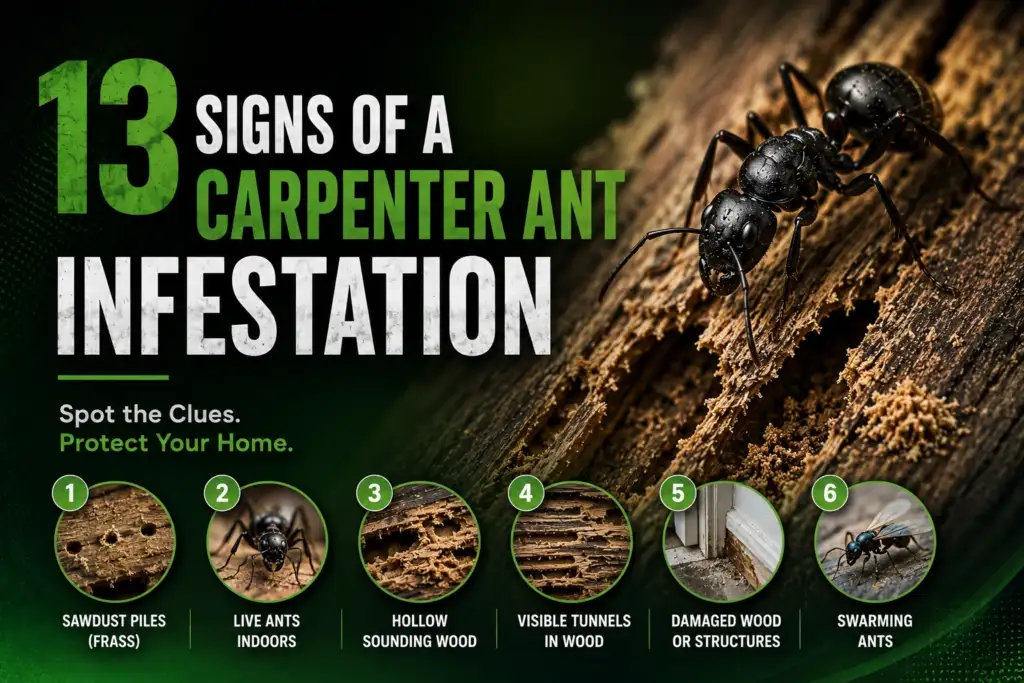
Carpenter ant infestation signs follow predictable patterns once you know where to inspect. The following 13 signs of a carpenter ant problem appear indoors and outdoors during active colony expansion.
- Large black ants in house environments, especially after dark, signal an active problem. Foraging workers emerge at night to seek food and moisture.
- Sawdust piles near baseboards, window sills, or wooden beams indicate active excavation. Ants push this sawdust-like frass from kickout holes to keep galleries clear.
- Rustling or crinkling sounds inside walls reveal hidden nests and serve as key carpenter ants in walls signs. Active excavation produces audible noise in quiet rooms.
- Hollow-sounding wood when tapped with a screwdriver handle confirms interior damage. Extensive tunneling removes wood while leaving the surface intact.
- Flying carpenter ants, or alates, indoors during spring nuptial flight season indicate maturity. Swarmers emerge from a colony at least 3 to 6 years old.
- Smooth, clean galleries visible inside broken or exposed wood show ant occupation. Tunnel walls appear sanded, unlike the mud-lined channels termites create.
- Kickout holes in wood surfaces where ants push debris from tunnels measure 1/8 to 1/4 inch. These openings deposit sawdust-like piles near wood continuously.
- Ant trails leading to moisture sources such as sinks or drains guide nest location. Workers follow pheromone trails along baseboards and plumbing lines.
- Sagging or warped wooden structures with no visible water stain reveal hidden destruction. Internal tunneling weakens load-bearing members before external decay appears.
- Shed wings piled near windowsills or along baseboards mark swarmer activity. Winged ants in house environments shed wings after landing and crawl to begin new nests.
- Ants coming out of wall voids, electrical outlets, or crevices indicate satellite expansion. Secondary nests use these hidden highways to spread through the structure.
- Damaged wood concentrated near plumbing leaks or roof leaks attracts initial exploration. Moisture-damaged wood sustains excavation once workers establish galleries.
- Satellite ant activity in multiple rooms on different floors confirms a carpenter ant infestation in home structures. Parent colonies establish secondary nests once the primary site reaches capacity.
Early Warning Signs You Can Spot Tonight
Early warning signs of carpenter ants in house environments become visible after dusk. Inspect after dark with a flashlight to catch foraging workers. Follow trails from food sources back toward wall voids. Listen for rustling with a stethoscope pressed against suspected walls.
Structural Damage Red Flags
Carpenter ant damage progresses from cosmetic to structural when left untreated. Hollow beams compromise load-bearing capacity. Warped door frames indicate extended tunneling. Crumbling wood around plumbing fixtures signals active excavation.
I placed a stethoscope against a moisture-damaged bathroom vanity wall during a late-evening inspection and heard a distinct crinkling sound. The noise matched carpenter ants excavating galleries. A flashlight inspection 30 minutes later revealed fresh frass piled beneath the kickout hole.
Do not spray visible carpenter ants with over-the-counter insecticide. Surface sprays kill foraging workers but scatter the colony. Scattered satellite nests relocate deeper into wall voids and make professional treatment less effective.
Where Do Carpenter Ants Nest Inside a Home?
Carpenter ants require damp wood and consistent humidity to establish a carpenter ant nest in residential structures. Satellite colony expansion drives infestations from a single parent colony into multiple rooms and floors. Homeowners in the Northeastern and Midwestern United States encounter black carpenter ants most frequently. These regions host 8 documented Camponotus species, with Camponotus pennsylvanicus causing the majority of structural infestations.
Indoor nest locations center on moisture-damaged wood near hidden leaks. Window frames and door frames with moisture intrusion attract initial exploration. Areas under sinks and behind dishwashers with hidden leaks host satellite nests. Crawl spaces and basements with poor ventilation provide ideal humidity levels above 60%. Wall voids adjacent to plumbing lines allow hidden gallery expansion. Attic spaces with roof leaks or ice dam damage support colony survival.
Indoor Nest Locations
Check under kitchen and bathroom baseboards first. Inspect built-in cabinets where they meet walls or floors. Probe crawl space beams with a screwdriver to locate hollow sections.
Outdoor Parent Colony Signs
Outdoor parent colonies often reside in tree stumps, rotting logs, or firewood piles within 100 yards of the structure. Firewood stacked against exterior walls creates a direct bridge into the home. Look for frass at the base of deck posts. Check porch columns where wood meets soil. Any ant nest location within 100 yards of the foundation can seed an indoor infestation.
University of Minnesota Extension states that carpenter ants are very common in Minnesota. They can potentially damage homes and other wooden structures. The best method for controlling carpenter ants is to deliver insecticide into their nest.
Why DIY Sprays Fail and What Works Instead
Homeowners researching how to get rid of carpenter ants with store-bought sprays often make the problem worse. Surface sprays eliminate only 3% to 5% of the total colony. The parent colony and 95% of workers remain hidden inside wall voids. Disturbed satellite nests relocate within 24 to 48 hours. Baits require 2 to 4 weeks to reach the queen through trophallaxis. Direct nest injection by a licensed professional delivers the only reliable elimination. Integrated pest management combines moisture reduction, wood replacement, and targeted treatment.
The Spray Trap Homeowners Fall Into
Homeowners frequently ask why do I have carpenter ants despite regular cleaning. The answer lies in moisture and wood access, not sanitation. Visible ants represent less than 5% of the colony population. Spray repellents break trail pheromones and fragment the infestation. Fragmented colonies establish new satellite nests in previously unaffected areas.
Professional Treatment Methods
Pest management professionals locate parent colonies through frass mapping. They inject insecticide directly into galleries. They treat exterior perimeter entry points to prevent reinfestation. Professional pest control operators deliver carpenter ant treatment through direct gallery injection.
Carpenter ants bite when handled. They inject formic acid into the wound, which produces a sharp burning sensation. Wear gloves during any inspection and avoid disturbing active galleries.
How to Prevent Carpenter Ants From Returning
Moisture control and prevention form the foundation of long-term carpenter ant management. Eliminating moisture damaged wood removes the habitat that attracts ants in house environments.
- Repair plumbing leaks within 48 hours of detection.
- Replace rotted wood and damaged fascia boards immediately.
- Trim tree branches to maintain 6-foot clearance from rooflines.
- Store firewood 20 feet from the structure and 18 inches off the ground.
- Clean gutters quarterly to prevent overflow and wood saturation.
- Install vapor barriers in crawl spaces to reduce humidity below 60%.
Frequently Asked Questions About Carpenter Ant Identification
What do carpenter ants look like?
Carpenter ants are large ants with elbowed antennae, a single node at the waist, and an evenly rounded thorax when viewed from the side. Workers range from 1/4 to 1/2 inch. Most US species are black or red and black. Winged swarmers have front wings longer than hind wings.
Do carpenter ants eat wood?
Carpenter ants do not eat wood. They excavate smooth galleries inside damp or decaying wood to build nests. Their diet consists of insects, honeydew from aphids, and sugary foods. The sawdust-like frass they push from tunnels contains wood shavings, insect parts, and soil, not digested wood.
How can I tell carpenter ants from termites?
Carpenter ants have elbowed antennae, a pinched waist, and dark bodies. Termites have straight antennae, broad waists, and pale bodies. Winged ants have unequal wing pairs. Termites have equal-length wings. Ant tunnels are clean and cross the wood grain. Termite tunnels contain mud and follow the grain.
Where do carpenter ants nest in a house?
Carpenter ants nest in moisture-damaged wood near plumbing leaks, window frames, door frames, crawl spaces, and basements. They also establish satellite nests in wall voids and attics. Outdoor parent colonies often reside in tree stumps, rotting logs, or firewood piles within 100 yards of the structure.
When do carpenter ants swarm?
Carpenter ant swarmers emerge in spring when temperatures rise above 60 degrees Fahrenheit. Mated females shed their wings and establish new colonies. Swarmers indicate a mature parent colony that is at least 3 to 6 years old. Indoor swarmers in late winter signal an active nest inside the structure.
Conclusion
A single carpenter ant colony can contain 2,000 to 3,000 workers and survive for 15 years under a single queen. Early identification through frass piles, rustling sounds, and winged swarmers prevents the structural damage that costs homeowners an average of $2,500 to $5,000 in repairs.
Moisture control remains the most effective long-term defense because carpenter ants require damp wood to establish nests. Fix leaks promptly, replace rotted fascia boards, and inspect crawl spaces each spring. Store firewood 20 feet from your home and trim branches to maintain 6-foot roof clearance.
Schedule a professional carpenter ant inspection today and stop the damage before it spreads to load-bearing beams.