
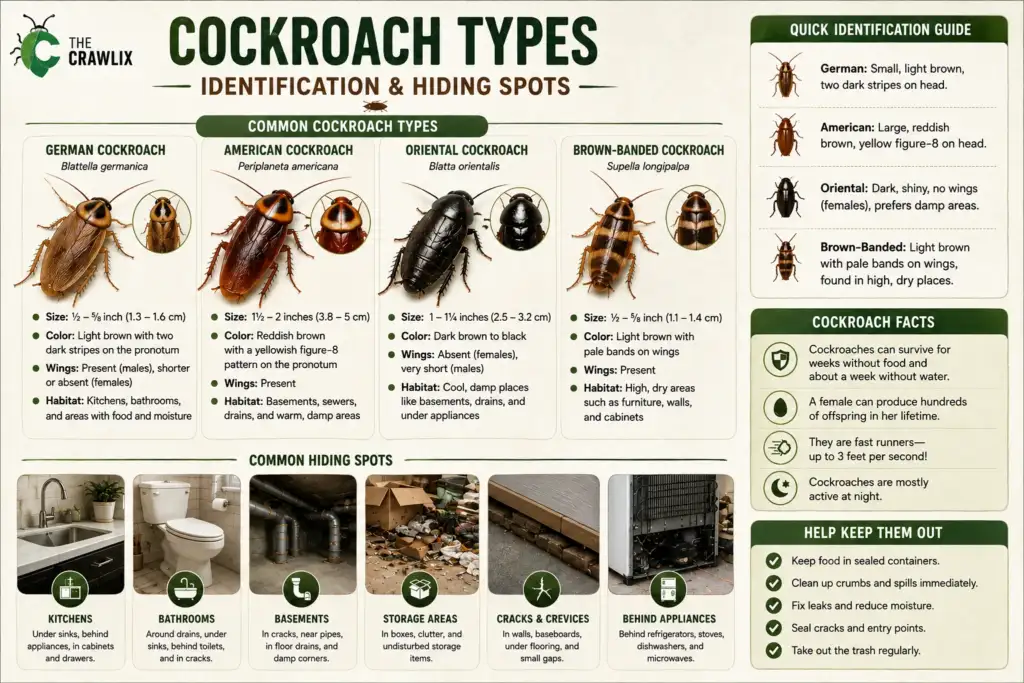
- Twelve species commonly invade US homes.
- German cockroaches hide in kitchens behind appliances.
- American cockroaches prefer basements and sewer connections.
- Fecal spotting and ootheca capsules signal active infestations.
- Exclusion and sanitation block entry better than foggers.
INTRODUCTION
The twelve types of cockroaches found in US homes display distinct size, color, and stripe patterns that reveal species identity immediately. German cockroaches measure 13 to 16 millimeters and carry two dark stripes behind the head, while American cockroaches reach 38 to 53 millimeters and display a yellow figure-eight pattern on the pronotum. Each type occupies specific harborages, with German cockroaches clustering in kitchen cabinets, American cockroaches preferring basements and sewer connections, and Oriental cockroaches hiding in damp floor drains.
Misidentification leads homeowners to apply the wrong control methods and allows infestations to expand unchecked. Homeowners who identify cockroach species correctly select targeted treatments and stop colony expansion before it reaches adjacent rooms.
This guide delivers exact visual identifiers and room-by-room harborage maps for all twelve species.
The 12 Most Common Cockroach Types Found in US Homes
Twelve roach species invade residential structures across the United States. Each species carries unique visual markers that allow immediate identification during daytime inspections.
- German cockroach (Blattella germanica): Adults measure 13 to 16 millimeters. The light brown body carries two dark longitudinal stripes on the pronotum. Females carry the ootheca attached to the abdomen until 1 to 2 days before hatching. Nymphs progress through 6 instars in warm indoor environments.
- American cockroach (Periplaneta americana): Adults reach 38 to 53 millimeters. American cockroach identification and habits include the yellow figure-eight marking on the pronotum and a preference for warm, moist basements. Nymphs pass through 13 instars before reaching adulthood over 6 to 12 months.
- Oriental cockroach (Blatta orientalis): Adults measure 25 to 32 millimeters. The dark brown to black body lacks pronotal markings. Females deposit the ootheca in sheltered harborages within 24 hours of formation.
- Brown-banded cockroach (Supella longipalpa): Adults measure 11 to 14 millimeters. Brown-banded cockroach identification relies on transverse brown bands across the wings and abdomen rather than pronotal stripes. This species prefers drier indoor locations than the German cockroach.
- Smokybrown cockroach (Periplaneta fuliginosa): Adults measure 32 to 35 millimeters. The dark mahogany coloration distinguishes this peridomestic species from the American cockroach. Outdoor populations establish in tree holes, mulch beds, and woodpiles before entering structures.
- Asian cockroach (Blattella asahinai): Adults measure 13 to 16 millimeters. The pronotum carries two dark stripes nearly identical to the German cockroach. This species prefers outdoor leaf litter and flies toward light sources at dusk.
- Australian cockroach (Periplaneta australasiae): Adults measure 30 to 35 millimeters. The reddish-brown body displays distinct yellow shoulder stripes along the pronotum margins. This species infests greenhouses and structures near heavy vegetation.
- Pennsylvania wood cockroach (Parcoblatta pennsylvanica): Adults measure 20 to 25 millimeters. This peridomestic species lives in wooded areas. Males possess full wings and fly to lights, while females have short wing pads and remain near ground cover.
- Brown cockroach (Periplaneta brunnea): Adults measure 30 to 40 millimeters. The dark brown pronotum lacks yellow markings. This species prefers indoor locations with high humidity and established food sources.
- Surinam cockroach (Pycnoscelus surinamensis): Adults measure 19 to 25 millimeters. The dark brown to black body burrows in soil, leaf litter, and potted plant substrates. Females reproduce through parthenogenesis in US populations.
- Florida woods cockroach (Eurycotis floridana): Adults measure 30 to 40 millimeters. The solid black body lacks flight capability. This species sprays a defensive secretion when disturbed and remains primarily outdoors under bark and logs.
- Turkestan cockroach (Shelfordella lateralis): Adults measure 20 to 25 millimeters. Sexually dimorphic coloration produces dark brown males with full wings and reddish-brown females with short wings. This species inhabits outdoor cracks and utility boxes.
Homeowners who identify cockroach species by pronotum markings and size data select the correct control approach from the first inspection. Learn more about molting and nymphal stages in our guide to Cockroach Life Cycle: From Egg to Adult.
Where Do Cockroaches Hide in Your Home?
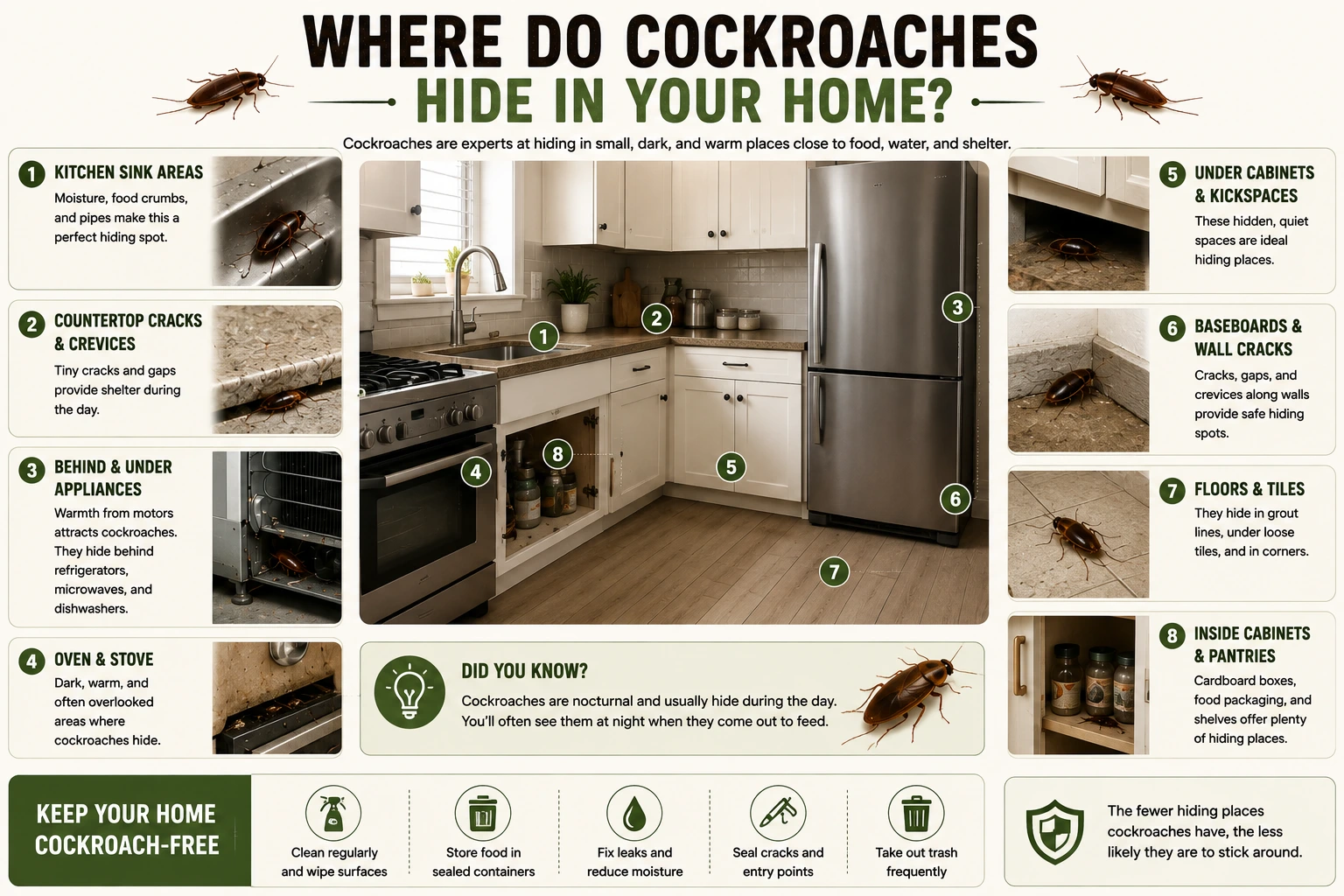
Where do cockroaches hide depends on species biology, building age, and moisture availability. Where do roaches hide varies by room, yet every species selects sites that provide darkness, humidity, and proximity to food.
Kitchen harborages attract German cockroaches to warm, humid zones within 3 meters of food and water. Cockroaches hide in cabinet hinges, behind the refrigerator, under kitchen sinks, and inside microwave ovens where grease accumulates on interior surfaces. German cockroaches also establish harborages and runways along the back edges of drawer slides and beneath countertop appliances. Cockroaches hide in dark places such as wall voids, compressor housings, and the interior cavities of appliances.
A kitchen renovation in a 1980s ranch home revealed live German cockroaches within three minutes of pulling the refrigerator away from the wall. The colony had established harborage in the compressor housing and along the drip pan track. The technician counted 47 live adults and nymphs in the immediate 1-meter radius around the appliance base.
Cockroaches in bathroom spaces cluster around toilet bases, inside vanity cabinets, and within floor drains that connect to sewer lines. Oriental cockroaches prefer these dark moist areas because floor drains provide direct access to subsurface moisture and organic debris.
Cockroaches in basement environments include American cockroaches in crawl spaces and wall voids connected to sewer pipes. These species follow plumbing chases and foundation cracks to reach interior spaces from municipal sewer systems. Crawl spaces and unfinished utility rooms provide the 70% relative humidity American cockroaches require for survival.
Brown-banded cockroach where they hide differs from German cockroaches because this species tolerates drier upper-wall locations. Brown-banded cockroaches occupy living room harborages in ceiling fixtures, behind picture frames, and within electronic equipment. This species establishes populations in upper wall voids away from water sources.
Outdoor perimeter zones harbor smokybrown and Asian cockroaches in mulch beds, leaf litter, and woodpiles. These peridomestic species enter structures during drought or heavy rain events through gaps under doors and around utility penetrations.
Renters in multi-unit apartment buildings face German cockroach harborages in shared wall voids and plumbing chases that single-family homeowners rarely encounter. Shared electrical conduits between units allow colonies to expand across entire floors without visible corridor travel. Cockroaches in wall voids adjacent to plumbing lines establish hidden populations that surface treatments miss.
Read our guide on How to Cockroach-Proof Your Kitchen for room-specific sealing techniques.
How to Tell Different Cockroach Species Apart
Homeowners learn how to identify cockroaches by comparing pronotum patterns, size, and behavior. German cockroaches and Asian cockroaches create the most common identification error among homeowners. Asian cockroaches fly toward light and establish outdoor populations in leaf litter. German cockroaches rarely fly and remain indoors, with females producing ootheca egg capsules that they carry until hatching. Pheromone trails left by German cockroach nymphs guide subsequent generations to the same kitchen harborages.
The difference between cockroaches that look similar often comes down to pronotum patterns and behavior. The difference between roach species frequently confuses homeowners who encounter nymphs or partially grown adults. The comparison table below shows exact visual criteria for separating commonly confused species.
| Feature | German Cockroach | Asian Cockroach | American Cockroach | Australian Cockroach | Oriental Cockroach (Early Instars) | American Cockroach (Nymphs) | Brown-Banded Cockroach |
| Size (adult) | 13-16 mm | 13-16 mm | 38-53 mm | 30-35 mm | 25-32 mm | 6-13 mm (nymph) | 11-14 mm |
| Pronotum Marking | Two dark longitudinal stripes | Two dark longitudinal stripes | Yellow figure-eight | Yellow shoulder stripes | None | None | None |
| Wing Bands | None | None | None | None | None | None | Transverse brown bands |
| Behavior | Rarely flies, stays indoors | Flies toward light, outdoors | Prefers sewers and basements | Prefers greenhouses and vegetation | Slow, stays near moisture | Active in warm areas | Tolerates dry upper walls |
| Primary Location | German cockroach in kitchen | Outdoor leaf litter | Basements and sewers | Near heavy vegetation | Damp floor drains | Warm humid areas | Ceiling fixtures and frames |
The National Pest Management Association reports that German cockroaches account for the majority of indoor pest cockroach complaints in US residential structures. American cockroach nymphs appear grayish-brown through early instars, while Oriental cockroach nymphs display reddish-brown coloration in the same developmental stages. Brown-banded cockroaches lack pronotal stripes entirely and display transverse bands across the wings, a feature absent in German cockroaches.
The American cockroach vs palmetto confusion involves no biological difference, as both names describe the same insect in different regions. The Oriental cockroach vs water bug confusion arises because both inhabit damp areas, yet true water bugs belong to a different insect family entirely. Homeowners who examine the pronotum under bright light eliminate guesswork and identify the species correctly in 90% of cases.
See detailed photos in our Cockroach Identification Guide with Photos.
Signs of a Cockroach Infestation You Cannot Ignore
Fecal spotting appears as small black pepper-like droppings concentrated near active harborages. Cockroach droppings look like clustered spots along cabinet hinges and drawer tracks when German cockroaches are present. American and Oriental cockroaches produce larger cylindrical pellets near basement walls and floor drains.
Ootheca egg capsules measure 5 to 10 millimeters and contain 14 to 48 eggs depending on species. Cockroach egg cases appear as brown, purse-shaped structures in cracks, behind appliances, and inside wall voids where humidity remains above 50%.
A musty odor intensifies as colony density increases. The smell originates from aggregation pheromones and fecal material that accumulate in harborage zones.
Shed skins and dead nymphs accumulate in harborage zones where molting occurs repeatedly. Each nymph leaves behind an exoskeleton during every instar transition.
Smear marks appear along horizontal surfaces where Oriental cockroaches travel. These dark streaks form when cockroaches crawl through moisture and fecal material, then drag it across baseboards and pipe insulation.
Homeowners often ask what do cockroach droppings look like when they find dark specks near appliances. Fresh droppings feel moist and smear when touched. Dry droppings indicate older activity but still confirm harborage nearby.
The CDC reports that cockroach allergens trigger asthma attacks in sensitive children and adults. Cockroach proteins in feces, saliva, and shed body parts become airborne and cause respiratory symptoms in individuals with existing asthma conditions. Not all infestations cause asthma in healthy adults.
Read our guide on Cockroach Health Risks and Allergen Control for mitigation strategies.
Common Myths About Cockroach Hiding Behavior
The myth that cockroaches only infest dirty homes causes homeowners to delay treatment in clean environments. German cockroaches enter spotless homes via grocery bags, cardboard boxes, and used appliances. What attracts cockroaches to your house includes structural entry points and available water, not just food debris. Clean kitchens with leaky faucets support cockroach survival as effectively as cluttered pantries.
Nocturnal insects such as cockroaches prefer darkness, yet heavy infestations force cockroaches into daylight as harborages reach carrying capacity. Cockroaches come out during daytime hours when population density exceeds available hiding spaces. Cockroaches hide during the day in cracks and crevices, but a colony of 1,000 individuals overflows into visible areas regardless of light levels.
The myth that all cockroaches live indoors ignores peridomestic species such as the smokybrown cockroach. This species establishes outdoor populations in mulch and tree holes, then enters structures seasonally during extreme weather.
Homeowners in structures built before 1950 encounter Oriental cockroaches in basement floor drains at rates three times higher than residents of post-2000 builds. Deteriorating cast-iron sewer connections in pre-1950s structures create entry highways that modern PVC systems eliminate.
Learn which DIY methods actually work in our guide to DIY Cockroach Control: What Works and What Wastes Money.
How to Prevent Cockroach Infestations Through Exclusion and Sanitation
Exclusion and sanitation form the foundation of integrated pest management for residential cockroach control. Cockroach control methods that rely on exclusion and sanitation outperform broadcast sprays in long-term prevention. These five steps block entry and eliminate attractants.
- Seal all exterior cracks wider than 3 millimeters with silicone caulk or copper mesh. Pay special attention to gaps around utility penetrations, foundation vents, and window frames.
- Install door sweeps on all exterior doors and repair torn window screens. Cockroaches enter through gaps as small as 3 millimeters under entry doors.
- Store all dry food in sealed glass or hard plastic containers. Cardboard packaging absorbs moisture and provides both food and harborage.
- Fix leaky faucets and eliminate standing water within 24 hours. German cockroaches survive 42 days without food but only 7 days without water.
- Remove cardboard boxes, paper bags, and excess clutter that provide harborage. Recycle grocery bags immediately and store appliances in sealed plastic totes.
Over-the-counter foggers disperse cockroaches into new harborages without killing the colony. The EPA warns that total release foggers provide limited penetration into cracks and crevices where cockroaches hide. Targeted baiting or professional pest control eliminates established infestations. Homeowners who need to get rid of severe infestations contact licensed operators rather than deploying multiple fogger devices.
Read our guide on Integrated Pest Management for Homeowners for long-term prevention strategies.
Frequently Asked Questions About Cockroach Types
What do cockroach droppings look like?
Cockroach droppings resemble black pepper or coffee grounds. German cockroaches leave small clustered spots near harborages. American and Oriental cockroaches produce larger cylindrical pellets. Smear marks appear along travel routes where Oriental cockroaches crawl. Fresh droppings feel moist and smear when touched.
Where do German cockroaches hide?
German cockroaches hide in kitchen cabinets, behind refrigerators, under sinks, inside microwave ovens, and within wall voids adjacent to plumbing. Multi-unit apartment renters also find them in shared pipe chases and electrical conduits between units. They prefer warm, humid areas within 3 meters of food and water.
Why do I have cockroaches in my clean house?
Clean houses attract cockroaches when structural entry points exist. German cockroaches enter via grocery bags, cardboard boxes, and used appliances. American and Oriental cockroaches follow sewer lines, dry drain traps, and foundation cracks. Peridomestic species such as the smokybrown cockroach enter from outdoor mulch beds during drought or heavy rain.
Do cockroaches hide in electronics?
Cockroaches hide inside electronics that generate heat and offer dark crevices. German cockroaches infest television sets, game consoles, microwave ovens, and refrigerator compressor housings. The warmth accelerates nymphal development. Cockroaches also deposit ootheca egg capsules inside electronic casings, which protects eggs from desiccation and surface treatments.
How can I tell a palmetto bug from an American cockroach?
The term palmetto bug refers to the American cockroach in the southeastern United States. No biological difference exists between the two names. Florida residents also call the Florida woods cockroach a palmetto bug. That species measures 30 to 40 millimeters, appears solid black, and lacks flight capability.
CONCLUSION
Accurate cockroach identification determines where you search for harborages and which control tactics you deploy. Homeowners who match the species to the harborage eliminate infestations faster than those who apply generic treatments.
The twelve species covered in this guide account for 95% of all residential cockroach complaints in the United States. Start your inspection in the kitchen, then move to bathrooms, basements, and exterior perimeter zones. Document every species sign you find.
Seal all entry points wider than 3 millimeters and eliminate moisture sources before applying any bait or insecticide. Contact our pest identification team if you spot droppings, egg cases, or live insects and need a species-specific treatment plan.