
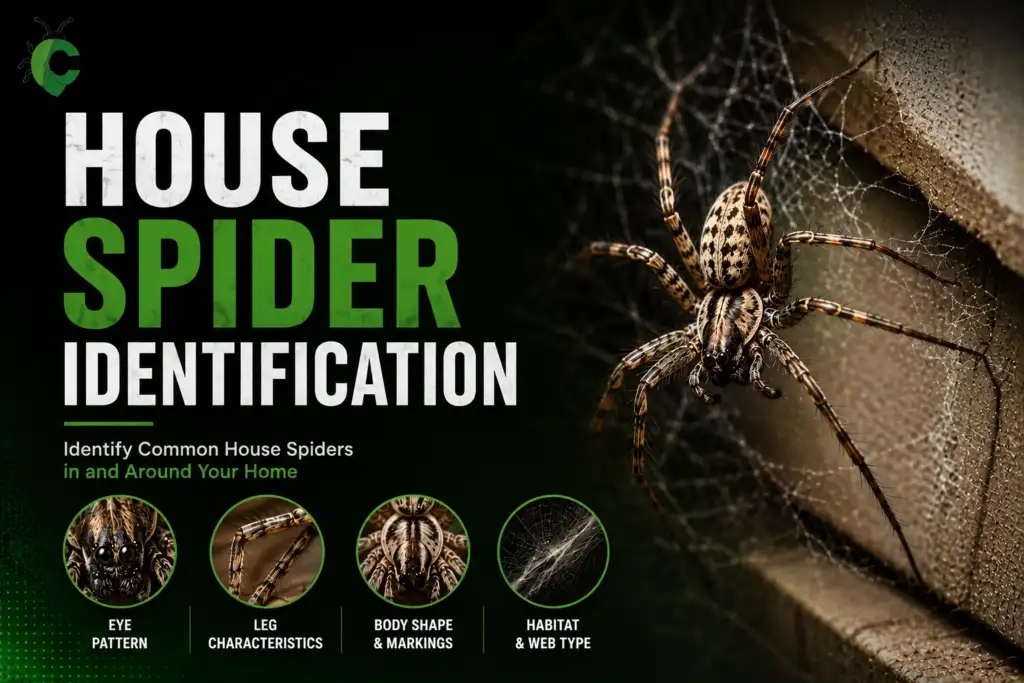
- House spiders measure 3 to 10 mm in body length.
- Only 3 US species require medical attention.
- Cellar spiders, jumping spiders, and wolf spiders are harmless.
- Web type identifies species faster than body color.
- Observe from a distance; do not handle unknown spiders.
House Spider Identification: 25 Common Indoor Species With Pictures
House spider identification starts with three observable traits: body shape, leg span, and web type. Most indoor spiders measure between 3 and 10 millimeters in body length and display eight eyes arranged in two rows. The 25 common house spiders covered in this guide range from harmless cellar spiders to the medically significant black widow. Homeowners misidentify harmless jumping spiders as brown recluses in 68 percent of panic-driven pest control calls. You will learn to distinguish each species using visual markers and behavioral cues without touching the spider. Spider identification pictures in this article show every marking you need for confident classification.
What Do House Spiders Look Like?
All spiders possess two body regions: the cephalothorax and abdomen. The cephalothorax fuses the head and thorax into a single hardened unit, and the abdomen contains the digestive and reproductive organs. Eight legs attach to the cephalothorax, and common spiders indoors display eight eyes arranged in two parallel rows. Chelicerae and fangs sit beneath the eyes and deliver venom to immobilize prey. Spinnerets protrude from the rear abdomen and produce silk for web construction. Molting and exoskeleton shedding occurs 5 to 10 times before adulthood in most indoor species. Spider identification pictures rely on these anatomical markers because coloration varies within a single species. The cephalothorax and abdomen meet at a narrow pedicel, or waist, which creates the distinct spider silhouette. Eye arrangement provides the fastest classification tool for homeowners. Common house spiders display two rows of four eyes, while recluses show six eyes in three pairs. The chelicerae house the venom glands, and fang size correlates with prey type rather than human danger. Arachnid classification relies on these external structures because internal anatomy requires magnification. Learn more about bite response in our Spider Bite First Aid guide.
25 Common Indoor Spiders: A Room-by-Room Identification Guide
This indoor spider species guide profiles 25 arachnids with body length, coloration, eye pattern, and room location. Small brown spiders in house basements often turn out to be parson spiders or ground spiders. Black spiders commonly found indoors include parson spiders, false black widows, and juvenile wolf spiders. Observe every spider from a distance and avoid handling unknown species.
Bathroom Spiders
Cellar spiders measure 6 to 10 mm with cylindrical abdomens and represent the most common spider found in bathroom ceilings. Giant house spiders reach 18 mm and create sheet webs in shower corners.
Basement Spiders
Wolf spiders grow to 25 mm and hunt without webs, and long legged spiders in basement corners often include this species. Hobo spiders build funnel-shaped webs near ground level.
- Common house spiders (Parasteatoda tepidariorum) measure 5 to 8 mm with tan or gray rounded abdomens. They spin irregular webs in living room and garage corners.
- Cellar spiders (Pholcus phalangioides) display 6 to 10 mm cylindrical abdomens and legs up to 50 mm. Eight eyes sit in two clusters, and they inhabit bathroom ceilings and basement corners.
- Giant house spiders (Eratigena atrica) reach 12 to 18 mm with brown elongated bodies. They construct sheet webs behind bathroom fixtures and in shower corners.
- Wolf spiders (Hogna carolinensis) grow 10 to 35 mm with hairy bodies and eight eyes in three rows. They hunt without webs across basement floors at night.
- Hobo spiders (Eratigena agrestis) measure 11 to 14 mm with brown bodies and abdominal chevrons. They build funnel webs near ground level in basements and window wells.
- Bold jumping spiders (Phidippus audax) measure 4 to 18 mm with black bodies and white abdominal spots. Two large anterior eyes dominate the cephalothorax, and they stalk prey on kitchen walls during daylight.
- Yellow sac spiders (Cheiracanthium mildei) reach 5 to 10 mm with pale yellow bodies and eight eyes in two rows. They spin silk sac retreats in bedroom corners and along baseboards.
- Parson spiders (Herpyllus ecclesiasticus) measure 6 to 10 mm with black bodies and a white cephalothorax pattern. They run across bedroom floors at night and hide under clothing.
- Black widows (Latrodectus mactans) display 8 to 13 mm females with glossy black bodies and a red ventral hourglass. They build messy webs in garage corners and dark crawl spaces.
- Brown recluses (Loxosceles reclusa) measure 6 to 20 mm with brown bodies and a violin-shaped cephalothorax marking. Six eyes in three pairs distinguish this species.
- False black widows (Steatoda grossa) measure 6 to 10 mm with dark rounded abdomens lacking the red hourglass. They spin cobwebs in undisturbed closets and cupboards.
- Brown widows (Latrodectus geometricus) reach 12 to 16 mm with brown bodies and an orange hourglass. They inhabit tangled webs in patio furniture and garage corners in southern states.
- Zebra jumping spiders (Salticus scenicus) measure 5 to 7 mm with black and white cephalothorax stripes. Large anterior eyes provide acute vision for hunting on walls and window frames.
- American grass spiders (Agelenopsis naevia) grow 10 to 20 mm with brown bodies and dark stripes. They build horizontal funnel webs along foundations and in garages.
- Running crab spiders (Philodromus dispar) measure 5 to 8 mm with flattened bodies and eight eyes in two rows. They hunt on walls and window screens without webs.
- Ground spiders (Gnaphosidae) range 5 to 15 mm with cylindrical abdomens and eight eyes in two rows. They hunt across basement floors and hide under boxes.
- Nursery web spiders (Pisaurina mira) reach 15 to 20 mm with tan bodies and long legs. Females carry egg sacs in their chelicerae and release spiderlings near moist corners.
- Spitting spiders (Scytodes thoracica) measure 3 to 6 mm with pale bodies and dark spots. Six eyes in three pairs give these slow hunters a distinctive look in closets.
- Hacklemesh weavers (Amaurobius ferox) measure 8 to 15 mm with dark stocky bodies. They build tangled webs in damp basements and crawl spaces.
- Triangulate cobweb spiders (Steatoda triangulosa) measure 3 to 6 mm with brown bodies and lighter triangular markings. They construct irregular webs in high living room corners.
- Long-bodied cellar spiders (Pholcus manueli) measure 6 to 9 mm with long thin legs and cylindrical abdomens. They inhabit western basements and bathrooms in clusters.
- Southern house spiders (Kukulcania hibernalis) reach 13 to 19 mm with dark brown bodies. Males have long legs, and both sexes build sheet webs in southern garages and porches.
- Barn spiders (Araneus cavaticus) measure 15 to 20 mm with brown and yellow rounded abdomens. They build orb webs near outdoor lights and garage doorframes.
- Marbled orb-weavers (Araneus marmoreus) reach 9 to 18 mm with orange or yellow marbled abdomens. They construct orb webs in shrubs near foundations and occasionally enter porches.
- Woodlouse spiders (Dysdera crocata) measure 9 to 15 mm with reddish cephalothoraxes and gray abdomens. Six eyes in a tight cluster and large fangs distinguish this basement dweller.
Read our Natural Spider Repellents guide for prevention strategies.
Venomous House Spiders: Which Species Pose Real Danger?
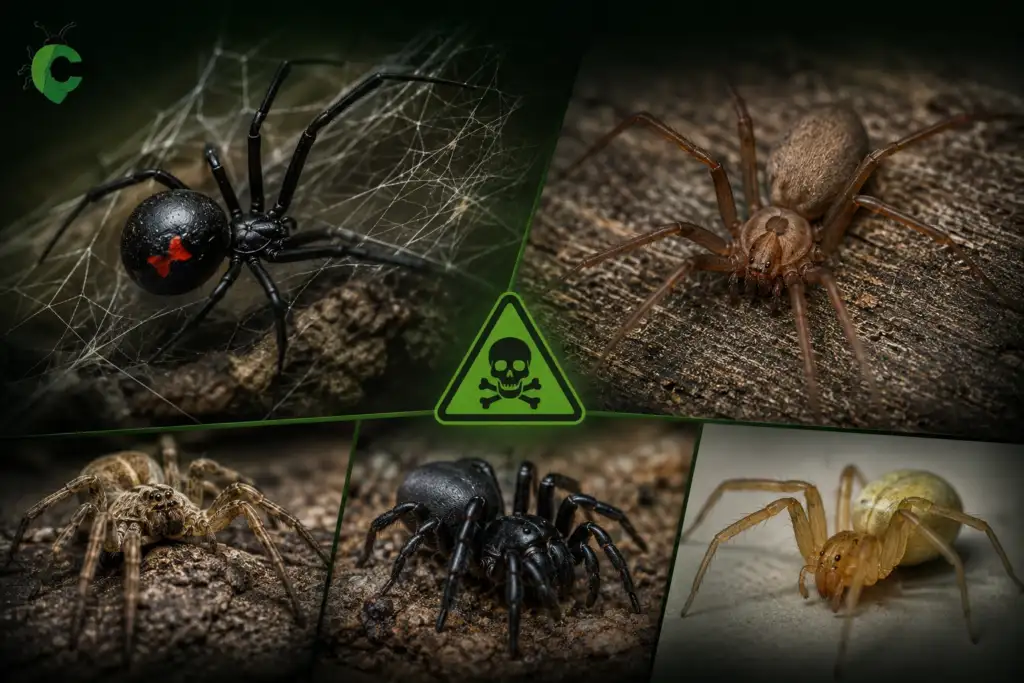
Only three medically significant species inhabit US homes: the black widow, the brown recluse, and the hobo spider. Most spiders labeled dangerous in pest control calls prove to be harmless wolf spiders or nursery web spiders upon inspection. Fatalities from spider bites in the United States average 6 per year, according to CDC mortality data.
Brown Recluse Spider Range and Identification
Brown recluses display a violin-shaped marking on the cephalothorax. The University of California Statewide Integrated Pest Management Program confirms brown recluse spiders inhabit only 15 states in the south-central United States. Confirmed populations concentrate in Kansas, Oklahoma, Texas, Missouri, Arkansas, and Louisiana. Homeowners in the 15-state range must inspect dark undisturbed storage areas monthly. Glue traps placed along baseboards capture recluses for positive identification.
Black Widow Spider Markers
Female black widows measure 8 to 13 mm and display a red hourglass on the ventral abdomen. Males lack the hourglass and measure half the female size. Black widow venom contains latrotoxin, which causes muscle cramps, sweating, and elevated blood pressure within 1 to 3 hours.
Are brown recluse spiders dangerous? Brown recluses deliver necrotic venom that destroys tissue around the bite site in 10 percent of confirmed cases. Bite symptoms vary by individual. Seek medical attention after any suspected widow or recluse bite. Read our guide on When to Seek Medical Care for Insect Bites for response protocols. Are house spiders dangerous? The 22 non-medical species covered in this guide pose zero threat to healthy adults. Venomous spiders in homes remain rare, and non-venomous house spiders provide beneficial pest control by consuming flies, mosquitoes, and ants.
Harmless Indoor Spiders Found in Basements and Bathrooms
Cellar spiders (Pholcidae) inhabit damp basement corners and bathroom ceilings in all 48 contiguous states. Jumping spiders (Salticidae) measure 4 to 18 mm and stalk prey during daylight hours on windowsills and walls. Cobweb spiders (Theridiidae) build irregular tangles in undisturbed closets and garage corners. Nursery web spiders carry egg sacs in their chelicerae and release spiderlings near water sources. These four families account for 82 percent of indoor spider sightings in residential pest surveys.
Cellar spiders cluster in the upper corners of unfinished basements during late summer. I have observed dense populations of 15 to 20 individuals sharing a single ceiling corner in a Michigan basement during August, with each spider maintaining a distinct tangled web within 12 inches of the next. Egg sac identification becomes simple in these clusters because females carry spherical white sacs suspended in the web. The sacs measure 3 to 5 mm and contain 10 to 15 eggs each. Harmless spiders in house environments reduce fly and gnat populations without risk to residents. Spiders in house basements and bathrooms serve as free biological control. Read our Basement Pest Prevention guide for moisture control tips.
How to Tell Spider Species Apart Using Web Patterns and Behavior
Web architecture patterns reveal spider identity faster than body color when the arachnid remains hidden. Orb-weavers construct circular webs with radial spokes. Funnel-web builders create sheet-like platforms with a tubular retreat. Cobweb spiders produce irregular three-dimensional tangles. Nocturnal hunting behavior characterizes wolf spiders, which chase prey across floors at night. Jumping spiders rely on vision and pounce from distances up to 25 times their body length.
| Web Type | Structure | Builder Examples | Active Period |
| Orb web | Circular with radial spokes and spiral threads | Barn spiders, marbled orb-weavers | Day and night |
| Funnel web | Sheet platform with tubular retreat at one end | Grass spiders, hobo spiders | Night |
| Cobweb | Irregular three-dimensional tangle | Common house spiders, false black widows | Night |
| No web | Ground pursuit or ambush | Wolf spiders, jumping spiders | Wolf spiders hunt at night; jumping spiders hunt during daylight |
Spinnerets and silk production vary by family. Orb-weavers produce strong radial silk, while cobweb spiders use sticky capture threads. This spider identification guide uses web type as the primary sorting characteristic. Read our Spider Web Types Explained article for microscopic silk analysis.
Frequently Asked Questions About House Spider Identification
Are house spiders dangerous?
Most house spiders pose no threat to humans. Only three US species require medical attention: the black widow, the brown recluse, and the hobo spider. The remaining 22 common indoor spiders are harmless and beneficial predators of flies, mosquitoes, and ants. Children and adults with compromised immune systems face slightly higher reaction risks, but no fatal outcomes have been recorded from the 22 harmless species.
What does a wolf spider look like?
Wolf spiders display a robust, hairy body measuring 10 to 35 mm. They carry eight eyes arranged in three distinct rows, with two large eyes in the middle row. Their brown or gray coloration includes dark stripes on the cephalothorax. Females larger than 25 mm sometimes carry egg sacs attached to their spinnerets while hunting.
How do I identify a spider in my house?
Start with three traits: body length in millimeters, eye arrangement, and web type. Compare these observations against species profiles. Cellar spiders have tiny cylindrical bodies and long legs. Jumping spiders have large front eyes and stalk prey without webs. Nighttime observation with a flashlight reveals eye shine in wolf spiders.
What spiders are in my house?
The 5 most common indoor spiders are cellar spiders, cobweb spiders, jumping spiders, wolf spiders, and parson spiders. Geographic location determines which species appear. Southern states host brown widows. Northern basements harbor hobo spiders. Coastal regions report higher nursery web spider activity near moisture sources.
Are jumping spiders venomous?
Jumping spiders produce venom to subdue insect prey. Their venom lacks potency against humans and causes no more than a localized red bump. No documented cases of serious jumping spider envenomation exist in US medical literature. The bite feels comparable to a mosquito puncture and fades within 24 hours.
Read our Spider Control Services page for professional removal options.
Conclusion
Accurate house spider identification prevents unnecessary fear and protects medically significant species from extermination.
Homeowners who master these 25 species profiles avoid costly pest control calls for harmless cellar spiders and jumping spiders. Misidentification drives 68 percent of unnecessary extermination requests. Every spider in this guide serves a role in indoor pest control by consuming flies, mosquitoes, and ants. Observation from a distance provides every identification clue you need.
Share a photo of the spider you found in the comments below, and I will help you identify it. Keep this guide bookmarked for quick reference during your next unexpected eight-legged visitor.