
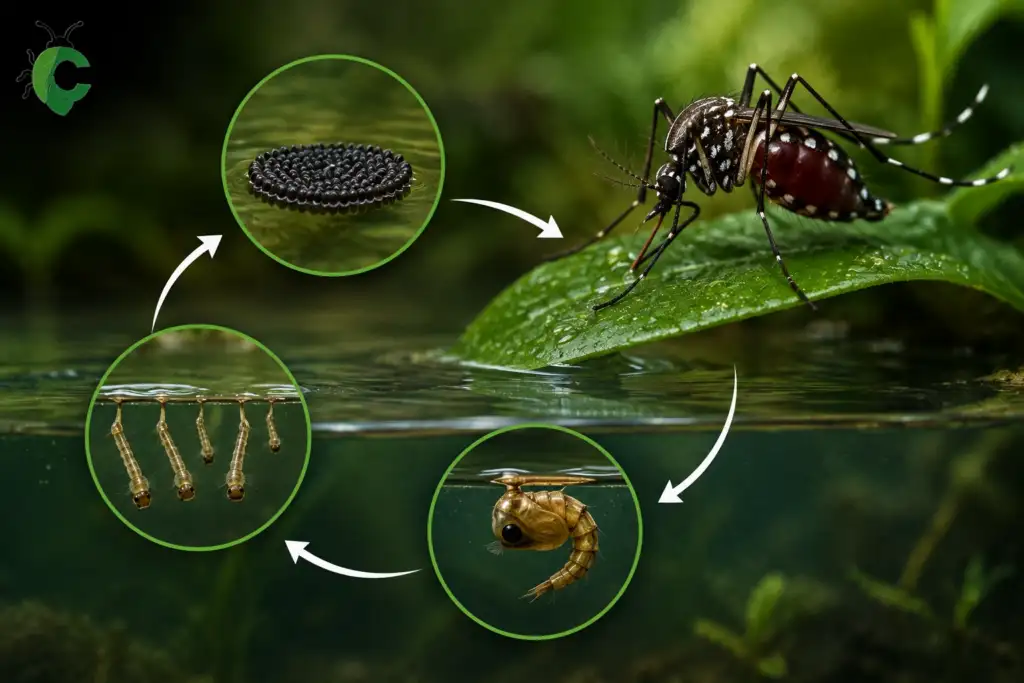
- The mosquito life cycle includes four stages: egg, larva, pupa, and adult.
- Most species complete the cycle in 8 to 10 days at 80F.
- Female mosquitoes require a blood meal to produce eggs.
- Eliminating standing water breaks the cycle before adults emerge.
- Adult lifespan ranges from 6 days (males) to 6 weeks (females).
Introduction
The mosquito life cycle consists of four distinct stages: egg, larva, pupa, and adult. Most species complete this cycle in 8 to 10 days when water temperatures hold near 80F. Each stage reveals exactly where and how to interrupt breeding before adult populations emerge. Homeowners often miss the brief pupal window, the last aquatic stage before adults take flight. This guide breaks down each stage with exact timelines, species-specific lifespan data, and actionable prevention steps you can apply today.
What Is the Mosquito Life Cycle?
Mosquitoes undergo complete metamorphosis, a biological process the CDC classifies as holometabolous development with four distinct phases. The total duration of the life cycle of mosquitoes depends on species and ambient temperature. Warmer water near 80F accelerates larval and pupal development, while temperatures below 60F extend the cycle to 30 days or more. Some species, including Aedes aegypti, deposit eggs that survive 6 months of drying and hatch after flooding rains. The mosquito life cycle explained in entomological terms follows this rigid sequence: egg to larva to pupa to adult, with no skipping or abbreviation of stages.
The Four Stages of Mosquito Development (Egg to Adult)
The four stages of mosquito development proceed in fixed order from egg through adult eclosion. Each stage occupies a specific time window and performs a distinct biological function. The following table summarizes stage, duration, and key characteristic.
| Stage | Duration | Key Characteristic |
| Egg | 1 to 3 days | Requires water contact to hatch |
| Larva | 4 to 14 days | Passes through four instars; filter-feeds |
| Pupa | 1 to 4 days | Non-feeding; transforms internally |
| Adult | Immediate emergence | Males emerge first; mates within 24 hours |
Stage 1: Eggs and Oviposition Sites
Female Culex mosquitoes lay 150 to 350 eggs in rafts on stagnant water surfaces. Aedes aegypti deposit eggs individually on damp surfaces near water. Mosquito eggs need water to trigger embryonic development, though some species survive extended desiccation. Oviposition sites range from tree holes to artificial containers. Female mosquito lays eggs in locations that retain moisture for at least 7 days.
Stage 2: Larvae and Aquatic Instars
Mosquito larvae develop through four aquatic instars over 4 to 14 days depending on temperature and food availability. Larvae in water hang inverted at the surface and breathe through a posterior siphon. Mosquito larvae breathe air through this siphon while feeding on microorganisms and organic debris. Mosquito larvae live in water exclusively; they never leave the aquatic environment until pupation. The aquatic instars increase in size from 1mm to 8mm before molting into pupae. Siphon breathing allows larvae to access surface oxygen without fully surfacing.
Stage 3: Pupa and Eclosion Process
The mosquito pupa stage lasts 1 to 4 days and resembles a comma in shape. The pupa does not feed during this period. The pupa remains mobile and responds to shadows by diving. Internal transformation produces wings, legs, and adult mouthparts. The eclosion process occurs at the water surface when the adult splits the pupal case and emerges. Adult mosquitoes emerge from the pupal case within seconds and rest on the water surface until their exoskeleton hardens.
Stage 4: Adult Mosquitoes and Nectar Feeding
Adult mosquitoes feed on nectar and plant sugars for daily energy. Both male and female adults visit flowers and fruit juices. Only females seek blood meals to develop eggs. Female mosquitoes bite humans and other mammals after detecting carbon dioxide, body heat, and lactic acid. Carbon dioxide detection occurs at distances up to 50 meters. Adult mosquitoes feed on nectar throughout their lives, while blood feeding remains exclusive to egg-producing females.
How Long Do Mosquitoes Live?
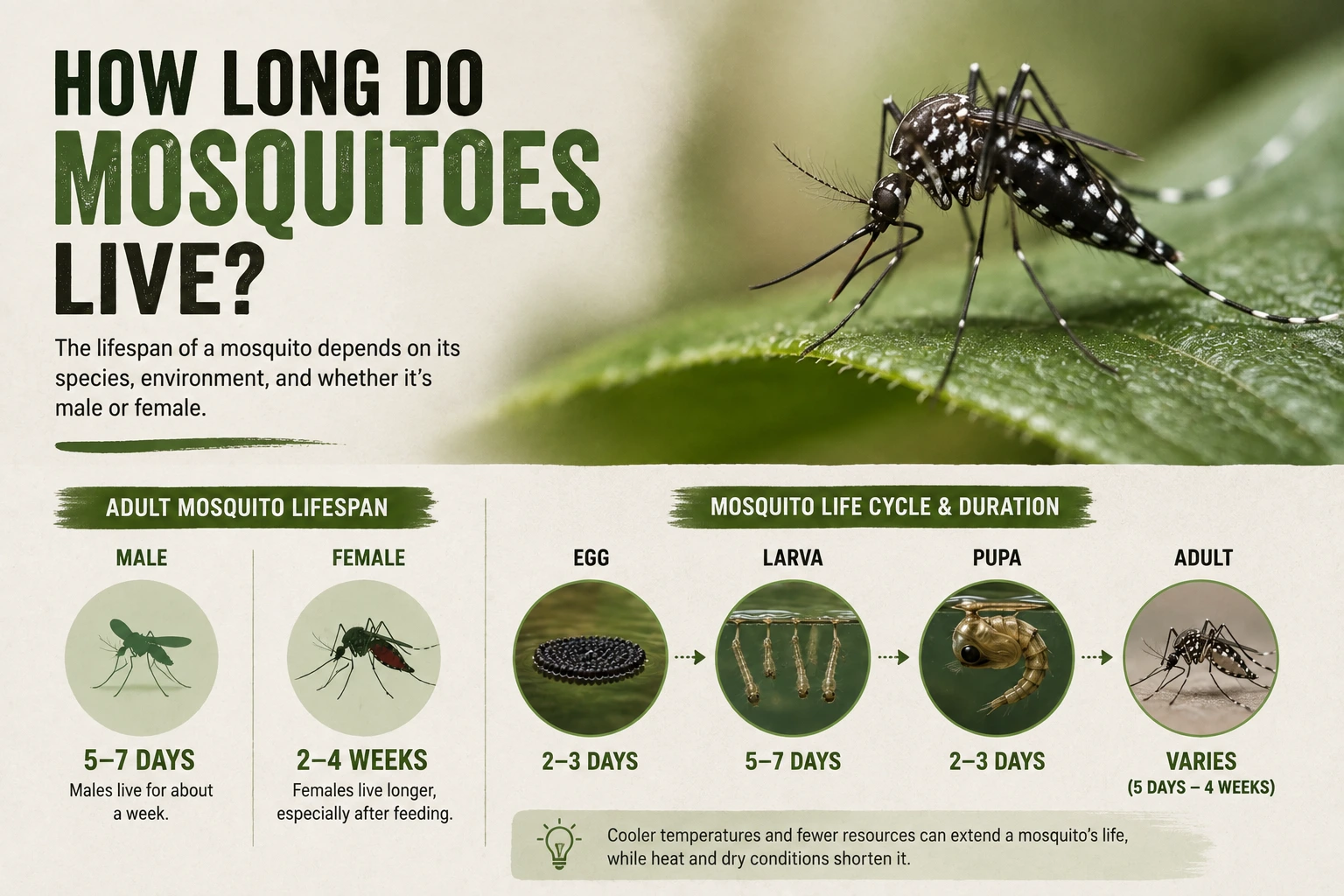
Adult mosquito lifespan varies by species, gender, and environmental conditions. The CDC notes that female Culex mosquitoes live 10 to 60 days depending on temperature and humidity. Adult mosquito lives for 6 to 10 days in males regardless of species. Female Aedes aegypti live 2 to 4 weeks under typical summer conditions. Blood meals extend female longevity and enable repeated egg production. Cold temperatures below 50F slow metabolism and extend lifespan in overwintering females.
| Species | Gender | Typical Lifespan | Conditions |
| Culex pipiens | Male | 6 to 10 days | Outdoor, warm |
| Culex pipiens | Female | 10 to 60 days | Outdoor, variable humidity |
| Aedes aegypti | Male | 6 to 10 days | Outdoor, warm |
| Aedes aegypti | Female | 2 to 4 weeks | Outdoor, tropical |
| Indoor populations | Female | 3 to 6 weeks | Stable temperature |
Male vs Female Mosquito Lifespan
Males die shortly after mating. Females store sperm and produce multiple egg batches across their lives. Each blood meal sustains 1 to 3 egg batches. Female mosquito needs blood to develop each clutch of 100 to 200 eggs. The mosquito lifespan for breeding females ranges from 10 to 60 days. Culex pipiens females produce 3 to 4 egg rafts in a lifetime.
Indoor vs Outdoor Survival
Indoor female mosquitoes live 3 to 6 weeks due to stable temperature and humidity. Outdoor females face predation, desiccation, and temperature extremes. Mosquito lifespan indoors exceeds outdoor survival by 2 to 4 weeks on average. Researchers measure how long can mosquitoes survive without food under laboratory conditions. Females live 2 to 3 days without a blood meal, while males survive 1 to 2 days without nectar. Search data shows the query ‘how long do mosquitoes live’ peaks each May. The related phrase ‘long do mosquitoes live’ ranks among the top mosquito lifespan searches. Climate data on how long do mosquitoes live in humid regions shows 10 to 15 day extensions over dry regions.
Where Do Mosquitoes Lay Eggs? Breeding Grounds Around Your Home
Mosquitoes require stagnant water for 7 to 10 days to complete aquatic stages. Residential yards contain more breeding sites than most homeowners recognize. Natural habitats include pond margins, marshes, and tree holes. Artificial containers produce the highest residential densities. Eggs in water hatch within 24 to 48 hours of contact. Where do mosquitoes lay eggs most frequently? US homeowners find 5 to 10 active breeding sites per quarter-acre lot during summer months. After a 3-inch rainfall last July, standing water in a single overturned planter saucer contained 12 larvae within 48 hours. The water temperature measured 78F.
Common Oviposition Sites in Residential Yards
Standing water around homes accumulates in unexpected places. Clogged gutters, bird baths, tire swings, plant saucers, pool covers, rain barrels without screens, and pet water bowls all harbor eggs. Female mosquito lays eggs in any container holding water for 3 consecutive days. Mosquito breeding grounds in residential areas outnumber natural habitats 3 to 1 in most US suburbs.
Natural Breeding Habitats
Natural habitats include pond margins, marshes, tree holes, flood plains, salt marshes, woodland pools, and drainage ditches. These sites support stable populations but remain harder to control. Stagnant water containers in natural settings produce fewer mosquitoes per square foot than residential yards.
How to Prevent Mosquito Bites and Stop Breeding
Consistent yard maintenance reduces biting populations and lowers arbovirus transmission risk. The following mosquito prevention tips target each life cycle stage. Source reduction stops mosquitoes from breeding by removing aquatic habitat before larvae mature. Integrated programs get rid of mosquitoes by combining source reduction with personal protection.
1. Eliminate Standing Water Weekly
Property owners walk their yards every 7 days to empty, scrub, and dry containers. Buckets, wheelbarrows, and kiddie pools require turning to remove habitat. Gutters require cleaning quarterly to prevent clogs. Rain barrels need fine mesh screens to exclude egg-laying females. Weekly elimination of standing water prevents eggs from hatching; once larvae appear, the 7-day maturation window closes rapidly. Standing water in plant saucers, bird baths, and pet bowls requires removal every 3 to 4 days.
2. Use EPA-Registered Repellents Correctly
EPA-registered repellents containing DEET, picaridin, or IR3535 provide proven protection. DEET at 20% to 30% concentration protects adults for 4 to 8 hours. Picaridin at 20% offers comparable protection. Oil of lemon eucalyptus (OLE) at 30% repels mosquitoes for 6 hours. Natural mosquito repellent options include OLE, though synthetic formulations last longer. Repellent application to exposed skin and clothing prevents mosquito bites. Guidelines on how to prevent mosquito bites on children emphasize proper application. EPA-registered repellents containing DEET are safe for children over 2 months when used as directed. Do not apply repellent to children’s hands, eyes, or mouth. Pregnant women should consult a physician before using oil of lemon eucalyptus products.
3. When to Call Professional Mosquito Control
Large infestations, confirmed arbovirus activity in the county, or persistent breeding in neighbor-managed properties justify professional intervention. Mosquito control methods for large areas include larvicide spraying and adulticiding. Mosquito borne diseases include West Nile virus, Zika, and dengue. Mosquito borne disease transmission risk increases when standing water persists for 10 consecutive days. Bti (Bacillus thuringiensis israelensis) treats ornamental ponds effectively. Bti remains non-toxic to humans and pets when users follow label rates for pond application. Yard spaces exceeding 0.5 acres require monthly treatments during peak season. Fine mesh screens (16 to 18 mesh per inch) on windows and doors prevent mosquitoes around your home. West Nile virus and other pathogens travel via mosquito vectors; confirmed local cases raise the urgency of professional control.
Common Myths About the Mosquito Life Cycle
Misconceptions about mosquitoes waste money and delay effective control. The following myths persist despite scientific evidence.
- Myth: All mosquitoes bite. Fact: Only females bite. Males feed exclusively on nectar. Mosquitoes live without blood easily; males never consume it.
- Myth: Mosquitoes die immediately in cold weather. Fact: Some species overwinter as adults in protected areas. Culex pipiens females survive winter in basements and culverts. Mosquitoes live without a blood meal for months during diapause.
- Myth: Citronella candles alone eliminate mosquitoes. Fact: They provide limited radius protection and do not kill larvae. The effective radius measures less than 2 meters.
- Myth: Bats and purple martins solve mosquito problems. Fact: These predators prefer larger insects and consume few mosquitoes. Studies show mosquitoes comprise less than 1% of bat diets.
Frequently Asked Questions About Mosquito Life Cycle
How long do mosquitoes live?
Most adult female mosquitoes live 2 to 6 weeks. Males survive 6 to 10 days. Lifespan varies by species. Culex pipiens females live 10 to 60 days. Aedes aegypti females live 2 to 4 weeks. Indoor females outlive outdoor females due to stable temperature.
What are the 4 stages of a mosquito’s life?
The mosquito life cycle four stages are egg, larva, pupa, and adult. Eggs hatch into larvae within 1 to 3 days. Larvae develop through four instars over 4 to 14 days. Pupae mature for 1 to 4 days before adult eclosion. The full cycle completes in 8 to 10 days at 80F.
Where do mosquitoes lay their eggs?
Female mosquitoes lay eggs on stagnant water surfaces or damp soil near water. Common oviposition sites include bird baths, gutters, plant saucers, tire swings, and pond edges. Some Aedes species deposit eggs in dry areas that flood later. Eggs hatch within 1 to 3 days of water contact.
How can I prevent mosquitoes in my yard?
Empty and scrub standing water containers weekly. Clean gutters. Cover rain barrels with fine mesh. Treat ornamental ponds with Bti. Apply EPA-registered repellent before outdoor activity. Install 16 to 18 mesh screens on windows and doors. Remove leaf litter that holds moisture.
Why do mosquitoes need standing water?
Mosquito larvae and pupae are fully aquatic. Eggs require water to hatch. Larvae feed on microorganisms in water while breathing through a siphon at the surface. The pupal stage also occurs in water. Without standing water, the life cycle cannot progress past the egg stage.
Conclusion
Eliminating standing water breaks the mosquito life cycle at the larval stage. This single action prevents adult emergence more effectively than any repellent applied after biting begins. Property owners who remove breeding sites see 70 to 90 percent fewer bites within 14 days. Consistent yard maintenance reduces biting populations and lowers vector-borne illness transmission risk for your household. Source reduction costs less than reactive spraying and protects the entire neighborhood. Adult mosquitoes travel less than 200 meters from their birth site; local elimination produces immediate local relief. Which mosquito prevention method worked best in your yard? Share your experience in the comments below.