
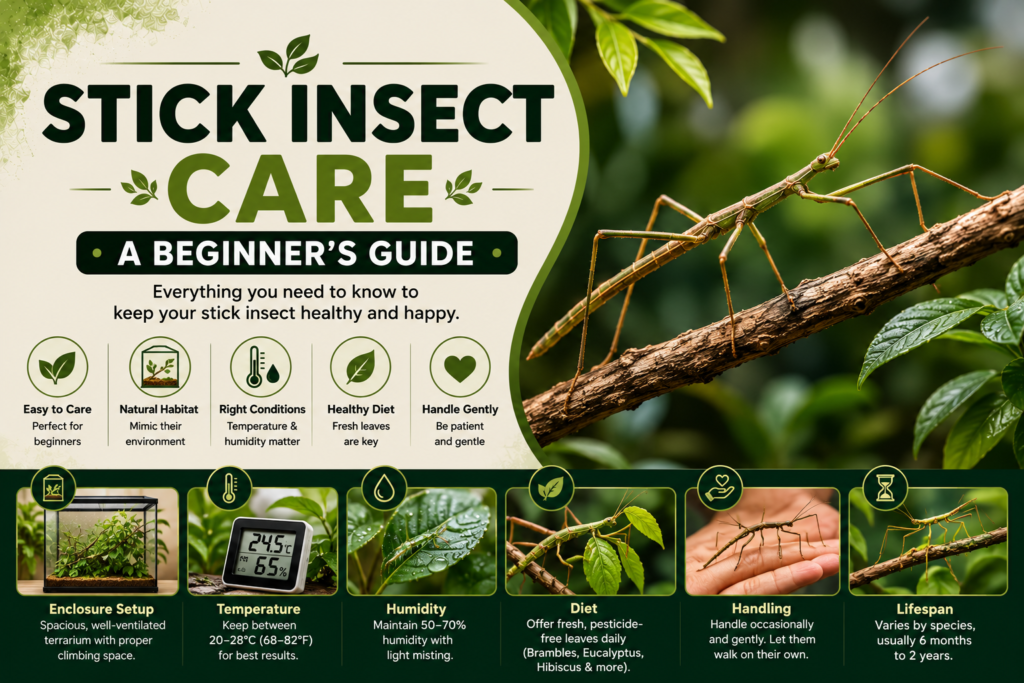
- Indian stick insects live 14 to 18 months and eat common garden leaves
- The enclosure requires 12 inches of vertical height for proper molting
- Room temperature between 70 and 75 degrees Fahrenheit sustains the species without heaters
- Females reproduce alone through parthenogenesis and lay 1 to 3 eggs daily
- A PPQ 526 federal permit is required for non-native species in the US
First-time owners keep stick insects as pets because the Indian stick insect is easy to keep for beginners, children, and classrooms. The Indian stick insect (Carausius morosus) lives 14 to 18 months, eats common garden leaves, and reproduces without a mate. A single individual requires a mesh enclosure 12 inches tall, room temperature between 70 and 75 degrees Fahrenheit, and fresh bramble or privet leaves changed every 3 to 4 days. Popular beginner guides skip the vertical space requirement. This omission causes molting failure in undersized enclosures. This stick insect care guide gives exact enclosure dimensions, a species-specific feeding chart, and the legal restrictions that apply to US keepers.
If you are new to identifying insects, our complete bug identification guide can help you understand the basic features used to distinguish different insects before choosing a species to keep.
What Do Stick Insects Eat
What do stick insects eat? Indian stick insects eat bramble, privet, ivy, hawthorn, oak, and hazel leaves. These six staples form the complete herbivorous insect diet for Carausius morosus. The insects ignore toxic plants but starve if keepers offer only unacceptable foliage. New keepers often assume stick insects nibble any green leaf. This assumption kills captive nymphs within days.
Safe Plants for Indian Stick Insects
Bramble and privet rank as the two most reliable food sources for captive Indian stick insects. Ivy, hawthorn, oak, and hazel round out the six accepted staples. Keepers must verify that all foliage comes from untreated sources. A single unacceptable plant species in the enclosure leads to starvation within 7 days. Wild foraging from unsprayed hedgerows provides the safest foliage source.
Garden insects vary widely in their diets and roles. If you also maintain plants around your enclosure or garden, learn about beneficial garden insects that provide natural plant protection to better understand which insects can be helpful rather than harmful.
The Pesticide Risk
Pesticide free leaves are mandatory for stick insect survival. Garden centers spray systemic insecticides that persist on leaves for weeks. Roadside plants absorb vehicle exhaust and herbicide drift. Ingestion of either source causes convulsions and death within 24 hours in Carausius morosus. Place stems in a water jar blocked with cotton wool to prevent nymph drowning. Change leaves every 3 to 4 days or when browning appears.
Tall Enough Enclosure for Stick Insects
A stick insect enclosure must provide three times the adult body length in vertical height. Carausius morosus reaches 3 to 4 inches as an adult and requires a minimum enclosure height of 12 inches (30 cm). Width and length must equal at least 2 times the adult body length. A mesh enclosure roof allows hanging during ecdysis. Paper towel substrate prevents mold and allows easy egg collection. Tall enough enclosure selection prevents the deformities that kill captive nymphs.
Because many household pests also spend much of their time hidden in cracks, corners, and sheltered spaces, understanding crawling insects that can hide around the home can be useful when you are learning how different insects use enclosed spaces.
Minimum Dimensions by Species
Species-specific sizing determines long-term survival. The comparison table below lists three common phasmid pets and their spatial needs.
| Species | Minimum Height | Minimum Width/Length | Roof Type |
|---|---|---|---|
| Indian stick insect | 12 inches | 8 inches | Mesh |
| Giant prickly stick insect | 18 inches | 12 inches | Mesh |
| Leaf insect | 10 inches | 6 inches | Mesh |
Why Height Matters More Than Floor Space
Nymphs hang upside down to shed. Limited vertical space causes incomplete ecdysis. The new exoskeleton hardens in a deformed position when descent is blocked.
An 8-inch jar caused molting failure in a third-instar Indian stick insect nymph I observed. The insect shed only half its exoskeleton before the container bottom blocked descent. The result was a permanently twisted abdomen. Space to molt is the single most critical factor in enclosure design.
Temperature and Humidity for Stick Insects
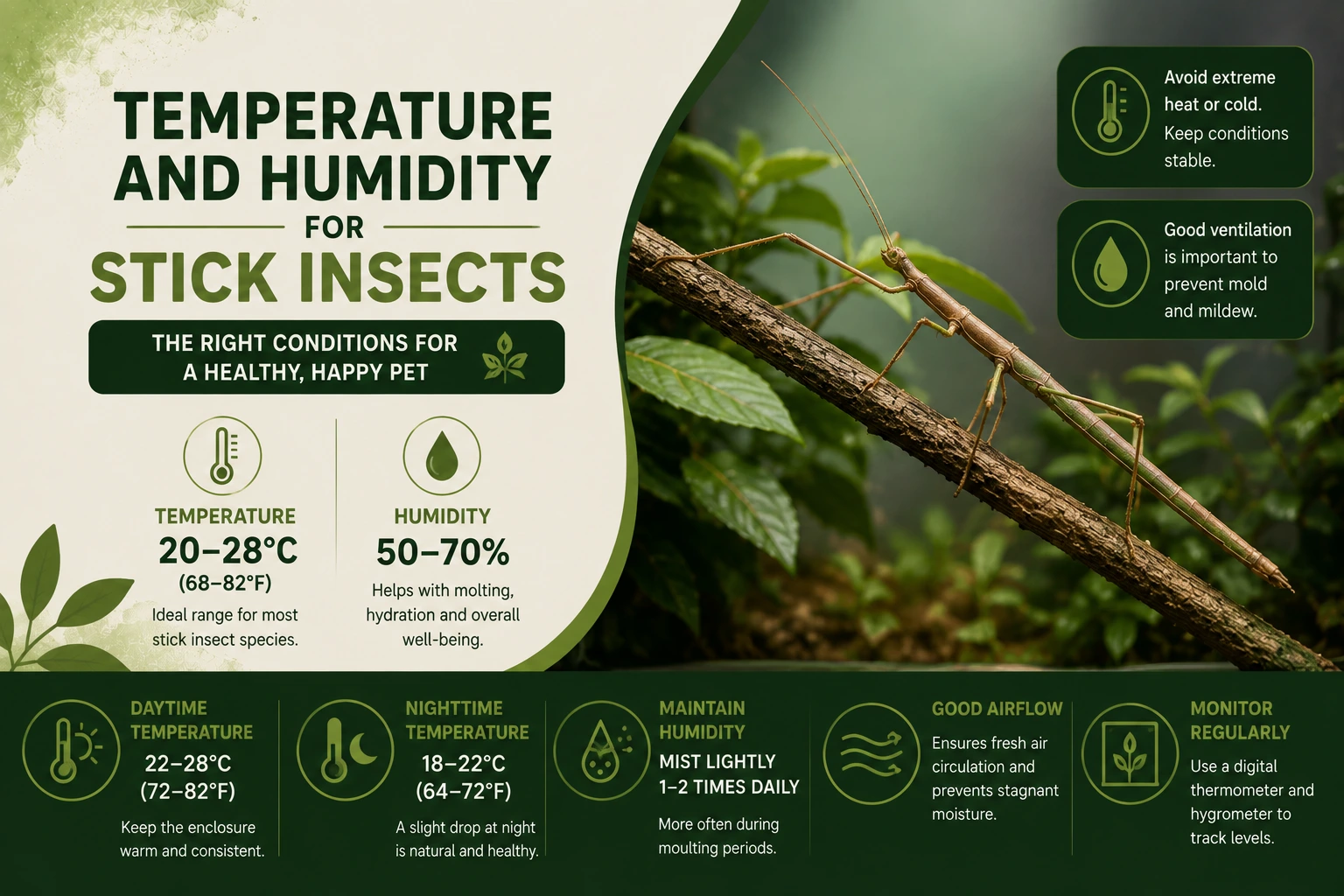
Indian stick insects thrive at 70 to 75 degrees Fahrenheit (21 to 24 degrees Celsius). Room temperature between 65 and 80 degrees Fahrenheit sustains common pet species without supplemental heating. Insects need humidity levels between 50 and 60 percent to prevent desiccation. Cross-ventilation prevents mold growth without lowering humidity below safe levels. Direct sunlight overheats the enclosure and kills the insect within hours.
The Misting Routine
Mist the enclosure once every 3 to 4 days using a fine spray bottle. Spray enclosure walls and leaves lightly. Nymphs drown in water droplets on flat surfaces. Vertical spray onto mesh or leaves eliminates this risk. Morning misting matches natural dew patterns and reduces nighttime chilling.
Nymph Drowning Risk
Nymphs can drown in standing water. Water droplets on flat surfaces trap nymphs. A single trapped nymph dies within 12 hours. Spray only onto vertical mesh or leaf surfaces. Flat enclosure floors must remain dry at all times.
Stick Insect Reproduction and Egg Care
Carausius morosus populations are exclusively female. Reproduction occurs through parthenogenesis. The Indian stick insect appears on every parthenogenetic species list for beginner phasmid keepers. Females drop 1 to 3 eggs daily while feeding or resting.
The UC Statewide IPM Program documents 10 to 12 week egg incubation and 5 nymphal instars for Carausius morosus. Each egg has a buff-colored operculum through which the nymph emerges. Eggs resemble frass but have a smooth texture. Frass is rough.
How long do stick insects live? The Indian stick insect lives 14 to 18 months from egg to natural death. Nymphs reach maturity in 6 to 8 months after 5 molts. Adult females live 4 to 6 months after the final molt.
Egg Disposal to Prevent Overpopulation
Eggs without male fertilization hatch into female nymphs. Freeze eggs for 48 hours before discarding. Unfrozen eggs hatch in substrate and create invasive populations. A female produces 200 to 300 eggs in her lifetime.
How Long Stick Insect Eggs Take to Hatch
Stick insect eggs hatch in 10 to 12 weeks at 70 to 75 degrees Fahrenheit. Cooler temperatures extend incubation to 16 weeks. Warmer temperatures above 80 degrees Fahrenheit reduce viability.
The Molting Mistake That Deforms Captive Nymphs
Stick insects undergo 5 nymphal instars before reaching adulthood. Each molt requires the nymph to hang vertically and slide out of its old exoskeleton. An enclosure 8 inches tall causes molting failure in Indian stick insect nymphs because the insect cannot fully extend its body during ecdysis.
Failed molts result in twisted abdomens, trapped limbs, or death. The old exoskeleton remains attached at the abdomen while the new one hardens in a deformed position. Incomplete metamorphosis depends entirely on successful ecdysis at every stage.
Signs of a Failed Molt
Twisted abdomen, permanently bent legs, and inability to climb after shedding are the three visible signs. The insect dies within 48 hours if the deformity affects the thorax. Space to molt is not the only requirement; the hanging surface must also support the full body weight.
Can Stick Insects Regrow Legs?
A lost leg grows back only during subsequent molts. A nymph that loses a leg at the third instar grows a replacement at the fourth instar. An adult that loses a leg after the final molt never regenerates it. The new leg emerges smaller and lighter in color but gains full function after 1 to 2 additional molts.
US Legal Restrictions on Non-Native Phasmids
USDA APHIS requires a PPQ 526 permit for the importation and interstate movement of plant-feeding insects, including non-native phasmids. The average permit processing time is 127 days. Containment facility inspection adds up to 20 weeks.
Private hobbyists do not receive PPQ 526 permits for non-native phasmids. APHIS issues these permits to zoos, universities, and research institutions. Native US species require no federal permit. State law determines additional restrictions.
Unpermitted possession of non-native phasmids carries federal penalties. State departments of agriculture enforce separate prohibited species lists at the state level.
Which Species Are Legal in the US?
Is it legal to keep stick insects as pets? Species native to your specific state require no federal permit. All exotic phasmid species require PPQ 526 authorization.
State departments of agriculture maintain separate prohibited species lists. Exotic pet legality by state varies, so check local regulations before purchase.
Frequently Asked Questions About Stick Insect Care
What do stick insects eat?
Indian stick insects eat bramble, privet, ivy, hawthorn, oak, and hazel leaves. Place fresh stems in a water jar blocked with cotton wool inside the enclosure. Change the foliage every 3 to 4 days. Never feed leaves from garden centers or sprayed roadsides; insecticide residue kills stick insects within 24 hours.
How long do stick insects live?
The Indian stick insect lives 14 to 18 months from egg to natural death. Nymphs reach maturity in 6 to 8 months after 5 molts. Adult females live 4 to 6 months after the final molt. Lifespan shortens at temperatures above 80 degrees Fahrenheit or below 65 degrees Fahrenheit.
Do stick insects need heat?
Indian stick insects thrive at 70 to 75 degrees Fahrenheit, which matches standard household room temperature. Supplemental heating is unnecessary in climates that maintain 65 to 80 degrees Fahrenheit indoors. Direct sunlight overheats the enclosure and kills the insect. A small heat mat raises the temperature only if your home drops below 65 degrees Fahrenheit consistently.
Can stick insects regrow legs?
Stick insects regenerate lost legs only during subsequent molts. A nymph that loses a leg at the third instar grows a replacement at the fourth instar. An adult that loses a leg after the final molt never regenerates it. The new leg emerges smaller and lighter in color but gains full function after 1 to 2 additional molts.
Are stick insects good pets for children?
Indian stick insects are good for kids aged 6 and older. Keepers must handle with care and use gentle encouragement rather than grasping. The insects have no stinger, no bite, and no venom. Children learn about incomplete metamorphosis, parthenogenesis, and camouflage through direct observation. Adult supervision prevents rough handling that causes limb loss.
Conclusion
For children learning about insects beyond stick insects, a common house bugs identification guide can provide a broader introduction to the insects they may encounter around the home.
The enclosure height determines whether your stick insect survives its next molt. A 12-inch minimum vertical space prevents the deformities that kill nymphs in undersized containers. Proper housing transforms stick insects from fragile captives into resilient classroom companions.
Stick insects offer a year-long, low-cost introduction to entomology for beginners who provide the correct vertical housing. Fresh bramble or privet leaves, room temperature between 70 and 75 degrees Fahrenheit, and a mesh roof satisfy every biological need of the Indian stick insect. This stick insect care routine requires less than 10 minutes per day.
Share your enclosure setup in the comments and tell us which leaf species your stick insects prefer.