
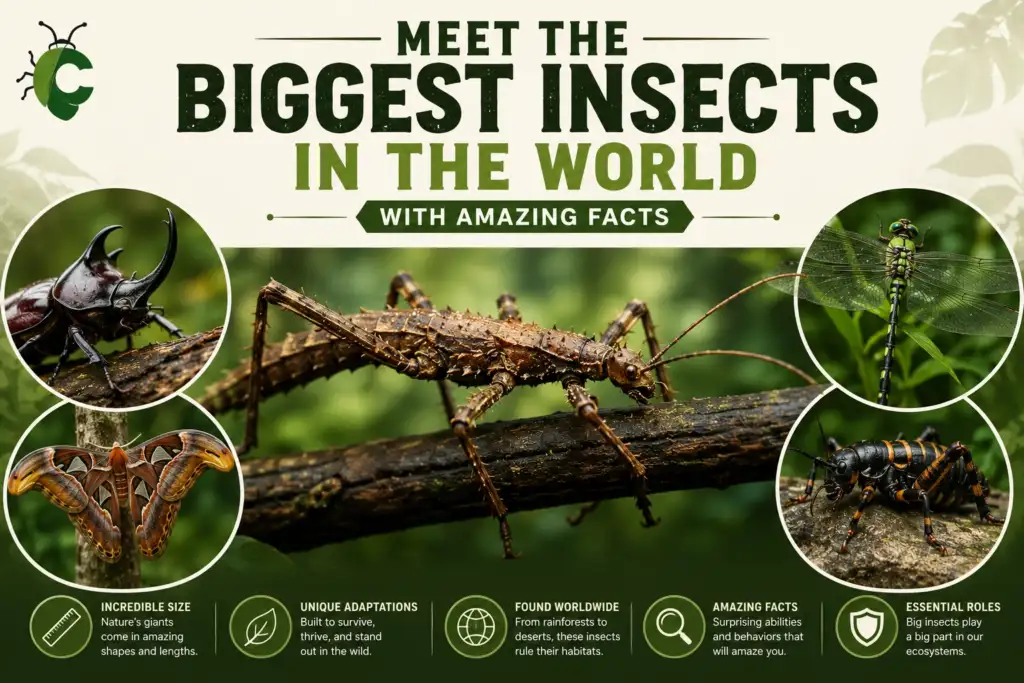
- Titan beetle: 6.6 inches, the largest beetle by length
- Atlas moth: 10.6-inch wingspan, the largest moth world record
- Giant wētā: 71 grams, the heaviest insect ever verified
- Meganeuropsis permiana: 28-inch wingspan, the largest insect ever to live
- Tracheal oxygen delivery limits modern insects to 6 to 7 inches
The biggest insects alive today include the titan beetle of the Amazon, which reaches 6.6 inches in body length; the atlas moth, with a 10.6-inch wingspan; and the giant wētā of New Zealand, which holds the verified weight record at 71 grams. Prehistoric griffinflies such as Meganeuropsis permiana dwarfed all modern species, sporting wingspans of 28 inches 285 million years ago. This article ranks the 10 largest insects by body length, wingspan, and mass, and explains the biological limits that prevent modern bugs from reaching prehistoric sizes.
Most lists of “biggest insects” confuse wingspan with body mass, leaving readers unsure which species actually holds the title of largest insect on Earth for each record category. By the end of this article, you will know the exact measurements, habitats, and biological constraints for every record-holding insect on the list.
The Titan Beetle in Amazon Rainforest Holds the Length Record
Titanus giganteus males reach 16.7 centimeters (6.6 inches) in body length, making this species the largest beetle by length among all living insects. No scientist has ever collected titan beetle larvae, but boreholes in dead trees measure 30 centimeters (1 foot) in length and 5 centimeters (2 inches) in width, revealing the probable larval dimensions.
The mandibles of adult titan beetles can snap a pencil in half and tear human flesh if the insect is handled or threatened. Adults do not feed; they live only a few weeks and focus exclusively on mating. The species inhabits tropical rainforest ecosystems across Bolivia, Brazil, Colombia, Ecuador, the Guianas, and Peru.
Atlas Moth Wingspan Reaches 10.6 Inches, Yet It Cannot Eat
Attacus atlas has a verified maximum wingspan of 27 centimeters (10.6 inches) and a wing surface area of 25 square inches. Adult atlas moths lack functional proboscises and do not feed after emerging from the cocoon. Their adult lifespan lasts only 1 to 2 weeks, powered entirely by energy stored during the larval stage.
Caterpillars reach 12 centimeters (4.7 inches) and feed on cinnamon, citrus, guava, and Jamaican cherry leaves. The snake-head markings on the wingtips mimic cobras to deter birds and lizards.
The Atlas moth I observed at the Natural History Museum in London sat motionless on a branch for 20 minutes. Its wingspan blocked my entire palm, and the snake-head markings on the wingtips twitched visibly when a child tapped the glass.
Giant Wētā New Zealand Claims the Heaviest Insect Title at 71 Grams
A pregnant female Little Barrier giant wētā (Deinacrida heteracantha) weighed 71 grams (2.5 ounces), verified by Guinness World Records. This mass exceeds the weight of a house sparrow.
Most adult wētāpunga weigh between 9 and 35 grams; the record holder was an extreme outlier filled with eggs. The species is endemic to New Zealand and faces habitat loss from introduced predators such as rats and stoats.
Conservation programs, including captive breeding at Auckland Zoo, aim to restore populations through endangered insect species conservation efforts. The heaviest insect in the world title belongs specifically to this pregnant female, not to the species average. How heavy is the heaviest insect? At 71 grams, the giant wētā New Zealand record holder weighs more than three standard AA batteries.
Queen Alexandra Birdwing Butterfly Faces Extinction at 28 Centimeters
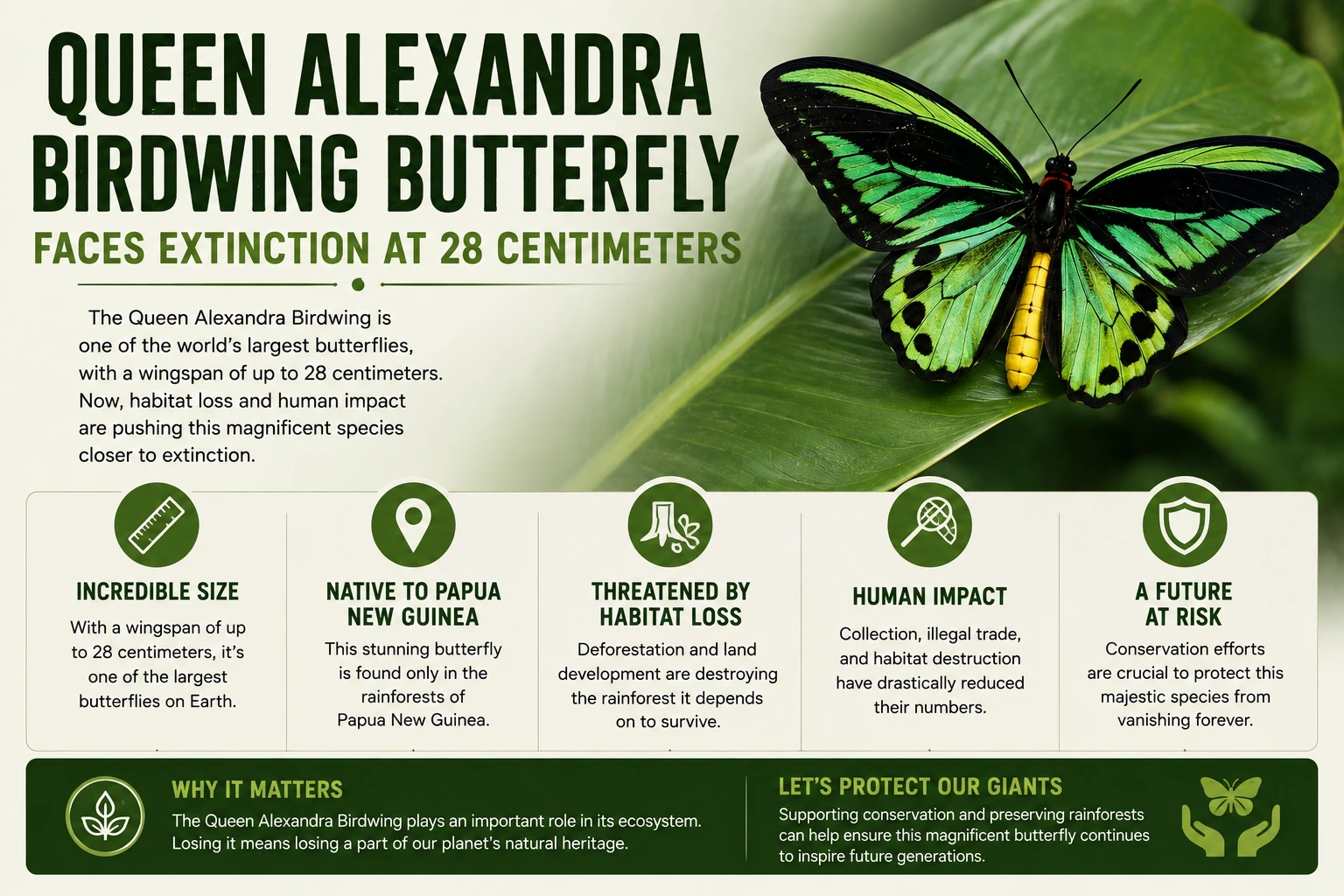
Female Ornithoptera alexandrae reach wingspans of 25 to 28 centimeters (10 to 11 inches). Males are smaller, averaging 16 to 20 centimeters, and display iridescent blue-green wings. This sexual dimorphism is among the most extreme in the Lepidoptera order.
The species is restricted to the Oro Province in eastern Papua New Guinea. Habitat destruction from palm oil plantations and oil drilling threatens the species across its limited range.
Conservation status details include:
- CITES Appendix I listing, which bans all commercial international trade
- Habitat loss from deforestation and agricultural expansion
- Dependence on Aristolochia vines for larval feeding
- Ecotourism and rainforest wildlife programs that promote habitat protection
The Queen Alexandra birdwing butterfly represents one of the most urgent insect conservation priorities on Earth. For more background on how butterflies develop through their different stages, see our butterfly life cycle guide.
Hercules Beetle Size Includes a Horn That Doubles Its Length
Dynastes hercules males reach 173 millimeters (6.8 inches) in total length when the thoracic horn is included. The horn itself accounts for half of the male’s total length. Females lack horns and average 62 millimeters in body length.
The elytra (hardened forewings) shift from olive-green to black based on humidity via hygrochromic microstructures. Larvae pass through 3 instars over 12 to 18 months and can weigh more than 100 grams before pupation. Adults live 3 to 6 months and feed on rotting fruit and tree sap.
The Hercules beetle size variation between males and females demonstrates extreme sexual dimorphism common in rhinoceros beetles. Arthropod exoskeleton limitations allow the horn to function as a lever during male combat for mating rights.
Longest Stick Insect Ever Measured Stretches 25.2 Inches
A captive female Phryganistria chinensis from Guangxi, China, reached 64 centimeters (25.2 inches) in total length. This specimen holds the Guinness World Record for longest insect.
The longest stick insect ever record has changed hands twice in the past two decades:
- Phobaeticus chani of Borneo reaches 36 centimeters in body length and held the record from 2008 until 2016.
- Phryganistria heusii yentuensis from Vietnam reaches 32 centimeters in body length, or 54 centimeters with forelimbs extended.
- Phryganistria chinensis now holds the official record at 64 centimeters total length.
All stick insects are herbivorous and rely on camouflage rather than flight for predator evasion. Entomology and biodiversity researchers continue documenting new Phasmatodea species from Southeast Asian rainforests.
Tarantula Hawk Wasp Delivers the Second Most Painful Insect Sting on Earth
Pepsis pulszkyi is the largest tarantula hawk species, reaching 2.7 inches in body length with a 4.5-inch wingspan. The sting of Pepsis grossa ranks second to the bullet ant on the Schmidt Pain Index. Females paralyze tarantulas and lay eggs inside the spider’s abdomen; larvae consume the host alive.
The stinger exceeds 0.25 inches in length. These wasps inhabit the southwestern United States, Mexico, Central America, and South America.
The sting causes immediate, incapacitating pain. Individuals with insect venom allergies must avoid handling or provoking these wasps. Predatory insect behavior in tarantula hawks represents one of the most specialized parasitoid strategies in the insect world.
Prehistoric Giant Insects With Wingspans of 28 Inches Ruled the Skies
Meganeuropsis permiana, a griffinfly from the extinct order Meganisoptera, had a wingspan of 71 centimeters (28 inches). Its body reached 43 to 47 centimeters (17 to 19 inches) in length. The species lived during the Early Permian, 285 million years ago.
The atmosphere at that time contained 30 to 35 percent oxygen, compared to 21 percent today. Griffinflies were not true dragonflies but distant stem relatives of modern Odonata.
Carboniferous period megafauna included additional giant arthropods such as Arthropleura, though Meganeuropsis permiana wingspan remains the largest insect ever to live record. Atmospheric oxygen levels at 30 to 35 percent enabled this extreme body plan.
Fossil evidence from the Wellington Formation in Kansas provides the primary specimens for this species. Prehistoric insects with wingspans exceeding 2 feet represent the absolute upper limit of insect size in Earth’s history.
Why Can’t Insects Grow Bigger? The Tracheal System Sets the Limit
Insects breathe through spiracles, which are external openings that connect to branching tracheae. The tracheal system delivers oxygen directly to tissues without blood transport. As insects grow larger, tracheal tubes occupy an increasing fraction of body volume.
A 2006 study led by Alexander Kaiser at Duke University used synchrotron X-ray imaging at Argonne National Laboratory to show that the leg-body orifice creates a spatial bottleneck. The researchers calculated that beetles cannot exceed 15 centimeters in today’s atmosphere, a prediction that matches the 16.7-centimeter titan beetle. Higher atmospheric oxygen during the Carboniferous and Permian periods reduced the tracheal volume needed, enabling griffinfly gigantism.
According to the research team from Duke University (Alexander Kaiser, Wah-Keat Lee, Jon F. Harrison) and their 2006 synchrotron X-ray study on tracheal scaling in beetles, published via Argonne National Laboratory and presented at Comparative Physiology 2006, the insect respiration tracheal system creates a hard ceiling on body size.
Why can’t insects grow bigger? The physics of oxygen diffusion through tracheae limits every living insect to a fraction of prehistoric sizes. Why are insects so small today? Atmospheric oxygen at 21 percent forces tracheal tubes to consume body space that would otherwise support tissue growth. How big can insects get? Modern atmospheric conditions cap most beetles at 15 centimeters, though the titan beetle reaches 16.7 centimeters through exceptional tracheal architecture.
Frequently Asked Questions About the Biggest Insects in the World
What is the largest insect in the world?
“Largest” depends on the metric. The titan beetle holds the length record at 6.6 inches. The atlas moth holds the wingspan record at 10.6 inches. The giant wētā holds the weight record at 71 grams. For readers interested in identifying insects beyond the record-breaking species discussed here, see our complete bug identification guide.
How big can insects get?
Modern insects are limited by tracheal oxygen delivery to 6 to 7 inches in body length. Prehistoric griffinflies reached 28-inch wingspans when atmospheric oxygen was 35 percent.
Where do Titan beetles live?
The Amazon rainforest regions of Bolivia, north-central Brazil, Colombia, Ecuador, the Guianas, and Peru host Titanus giganteus populations.
What insect has the largest wingspan?
The atlas moth (Attacus atlas) holds the wingspan record at 10.6 inches for extant insects. The white witch moth exceeds this at 14 inches but has less total mass and surface area.
What was the largest prehistoric insect?
Meganeuropsis permiana, with a 28-inch wingspan, lived during the Early Permian period 285 million years ago.
Conclusion
The size of every insect alive today is bounded by the physics of tracheal oxygen delivery. The titan beetle, atlas moth, and giant wētā each push that boundary to its absolute limit in length, wingspan, and mass respectively.
You now possess precise measurements and biological explanations that separate factual records from internet exaggeration. No list will confuse wingspan with body mass again, because you understand the distinct metrics that define insect size records. The amazing insect facts in this article reveal how atmospheric chemistry, predator evasion, and sexual selection shape insect dimensions across evolutionary time.
Subscribe to our weekly wildlife newsletter for more record-breaking animal facts delivered straight to your inbox.