
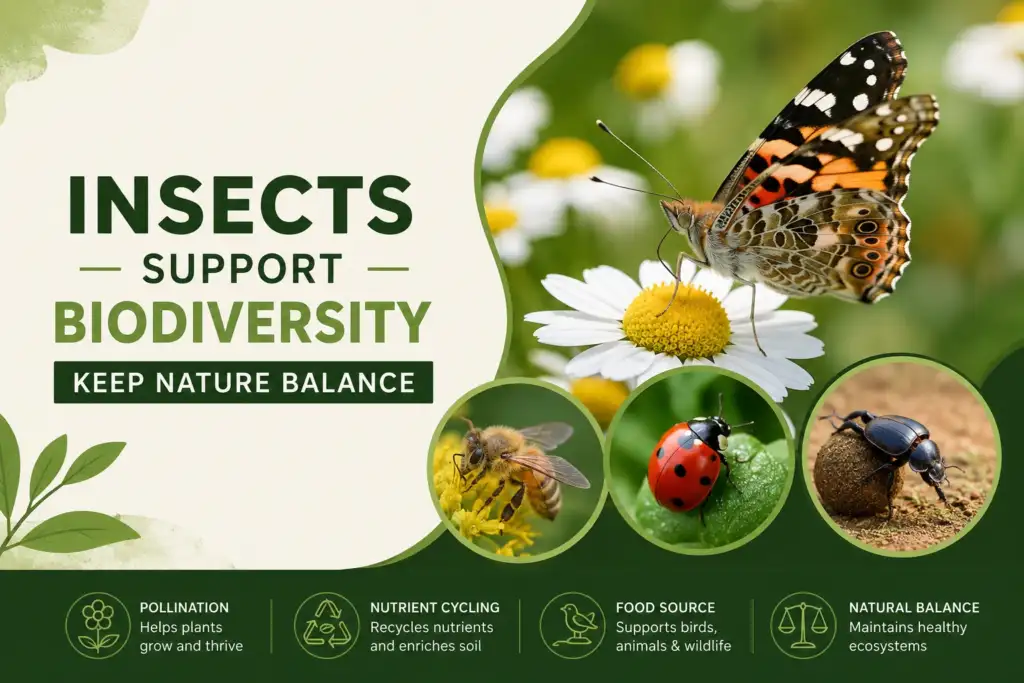
Insects support biodiversity and keep nature in balance through four primary mechanisms. Pollination of 35% of the world’s food crops and over 80% of wild flowering plants depends on insects. Decomposition and nutrient recycling rebuilds soil. Natural biological control of agricultural and forest pests reduces chemical dependency. Foundational support of food webs sustains birds, mammals, and amphibians. These ecosystem services generate over $235 billion in global agricultural value annually. The loss of insect populations triggers trophic cascade effects that destabilize entire ecosystems.
Most people view insects as pests to eliminate, not as the keystone organisms that maintain the ecological systems human survival depends on. By the end of this article, you will understand exactly how insects function as ecosystem engineers, why their decline threatens global food security, and which conservation actions protect insect biodiversity in your own community.
- Insects pollinate 35% of food crops and 80% of wild plants.
- Insects decompose waste and recycle soil nutrients.
- Insects control pests without chemicals.
- Insects feed birds, bats, amphibians, and mammals.
- Insect pollination is worth $235 billion globally each year.
How Insects Support Biodiversity Through Pollination
Over 80% of all wild flowering plant species worldwide are pollinated by animals, mostly insects. The Food and Agriculture Organization of the United Nations confirms this figure. 35% of global food crop production depends on animal pollinators. Insect pollination enhances average crop yield between 18% and 71% depending on the crop species. In the United States, approximately 4,000 species of native wild bees contribute to agricultural pollination. Insect pollination services add more than $34 billion in economic value to US agricultural crops annually. Non-bee insects, including flies, wasps, beetles, and butterflies, provide 39% of visits to crop flowers.
A single bumblebee visited 12 squash flowers in 3 minutes on a community garden plot in central Ohio last July. The audible buzz pollination vibrated the flower anthers. A visible pollen load coated its hind legs. This single bee transferred enough pollen to set fruit on each flower. Wild bees in the United States perform this service across 130 agricultural commodities.
How Do Bees Support Plant Life?
Honey bees contribute up to $5.4 billion in US agricultural productivity. Native pollinators like bumble bees, butterflies, and moths fill critical seasonal and climatic gaps. Diverse pollinator communities act as insurance against climate change by ensuring pollination under varying temperature and precipitation conditions. Understanding the butterfly life cycle also helps explain how different insect stages contribute to ecosystems.
Insects as Natural Pest Control and Biocontrol Agents
Predatory insects control aphids, caterpillars, and scale insects in agricultural and garden ecosystems. Lady beetles, lacewings, and parasitic wasps form the core biocontrol guilds. A single lady beetle consumes up to 5,000 aphids during its lifetime. Learn more about ladybug diet, habitat, and garden benefits to understand why these predators are valuable allies for gardeners. Parasitic wasps lay eggs inside pest insects. The larvae consume the host from within, reducing pest populations without chemical intervention. Insects that help control agricultural pests reduce farmer reliance on pesticides, lowering input costs and chemical runoff. This biological control service is a subset of the broader ecosystem services provided by insects. Gardeners can also learn more about beneficial garden insects and natural plant protection before deciding how to manage pests.
Safety Note: Homeowners must consult their local cooperative extension service before introducing non-native biocontrol species. Invasive predatory insects disrupt local ecological balance and outcompete native species.
How Dung Beetles Help Soil and Why Insects Matter for Ecosystems
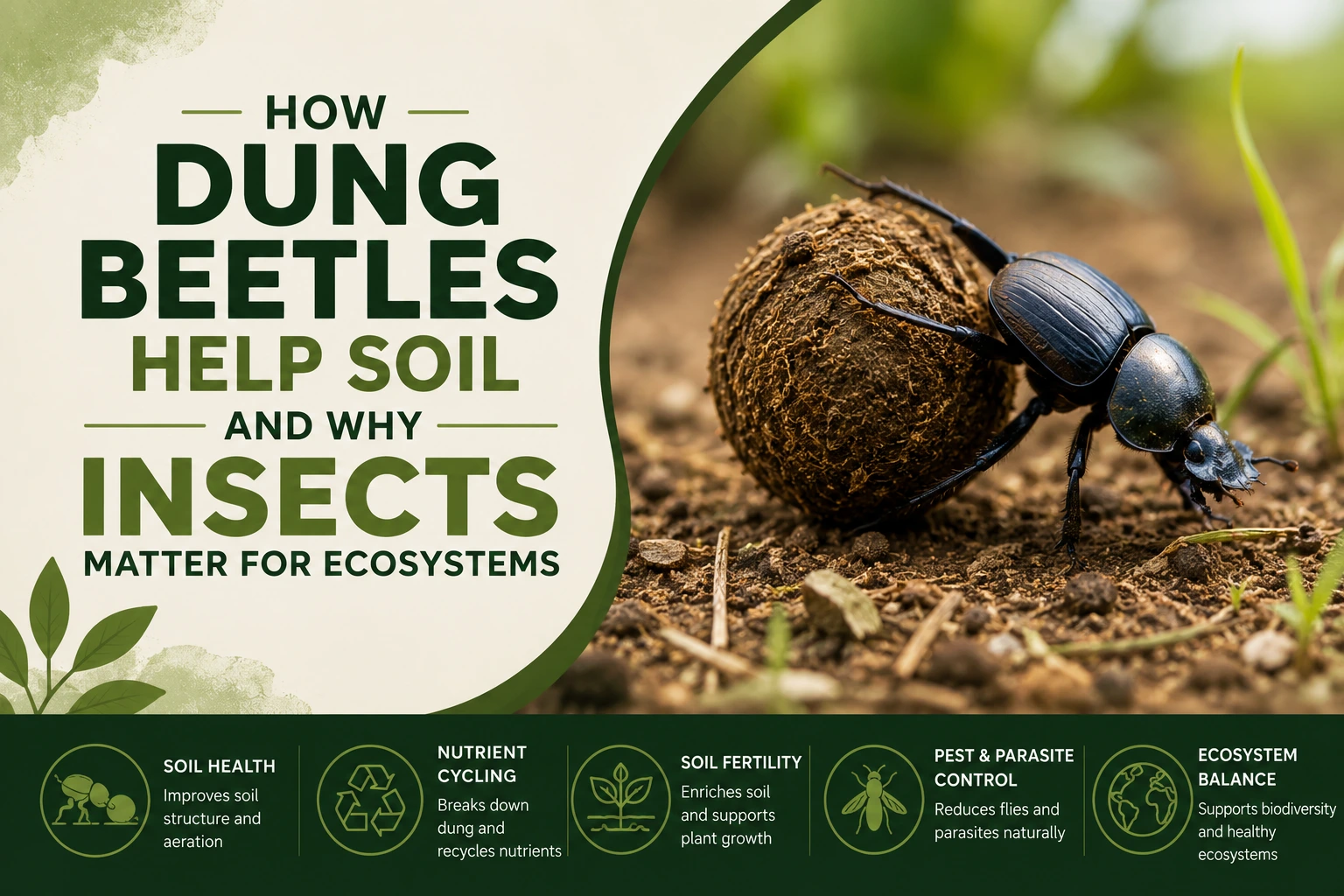
Dung beetles are ecosystem engineers that bury livestock dung, accelerating decomposition and returning nitrogen, phosphorus, and organic matter to the soil. Dung beetle activity increases organic matter and phosphorus concentrations at the soil surface by 50%. Tunneling dung beetles increase organic matter, total nitrogen, and phosphorus throughout the soil profile by 50% in semiarid pastures. Dung beetles reduce greenhouse gas emissions from dung pats: CO2 by 7%, N2O by 2%, and CH4 by 14.5% during grazing season. Dung beetles reduce approximately 70% of pest fly populations and 60% to 90% of parasitic nematodes in livestock dung.
The annual economic value of dung beetle ecosystem services is estimated at $5.9 billion in the United States (2005 dollars) and $425.9 million in the United Kingdom (2014 dollars). The Intergovernmental Science-Policy Platform on Biodiversity and Ecosystem Services (IPBES) recognizes these contributions in its Global Assessment Report. Losey and Vaughan (2006) published the foundational economic valuation of dung beetle services in the United States.
Detritivore food chains depend on beetles, fly larvae, ants, and termites to break down dead plant and animal matter. Termites and ants process dead wood and leaf litter, releasing locked carbon and minerals. Soil-dwelling insect larvae fragment organic matter, increasing surface area for microbial decomposition. This nutrient cycling supports plant growth across forest, grassland, and agricultural ecosystems.
Insects and the Food Chain: Trophic Cascade Effects
Insects form the basal energy layer of terrestrial and freshwater food webs. Insectivorous birds, bats, amphibians, reptiles, and small mammals depend on insect biomass for survival. Hallmann et al. (2017) documented a 76% decline in flying insect biomass over 27 years in German nature reserves. This decline correlated with population crashes in insectivorous bird species.
Lister and Garcia (2018) recorded a 98% loss of canopy-dwelling insects over 35 years in Luquillo Forest, Puerto Rico. This collapse preceded extinctions and population crashes in frog, lizard, and bird populations. Ecological redundancy means multiple insect species perform similar functions. This redundancy buffers ecosystems against species loss. When redundancy collapses, trophic cascade effects amplify across multiple trophic levels. Functional diversity among insects, varied mouthparts, life cycles, and habitat preferences, ensures continuous ecosystem service delivery across seasons and disturbances.
For readers interested in identifying the insects they encounter in these food webs, a complete guide to bug identification provides a useful starting point.
The Decline of Insects and Habitat Destruction Impact
The IPBES Global Assessment Report estimates that 10% of insect species face extinction risk. A later systematic review estimates over 40% of insect species are threatened with extinction worldwide. Insect biomass declines at an estimated rate of 2.5% per year in some regions. This rate compounds to a 20% loss in 10 years and a 52% loss over 50 years. Habitat destruction through urbanization and agricultural intensification is the primary driver of terrestrial insect decline. Pesticide use, light pollution, and climate change compound habitat destruction impact. Insect species decline triggers loss of biodiversity higher up in the food web, including insectivorous birds and amphibians. Anthropogenic pressures are the root cause of most insect population collapses.
What Happens If Insects Disappear?
Crop yields for almonds, apples, blueberries, cherries, and tomatoes would collapse without insect pollinators. Soil fertility would decline as decomposition slows. Pest outbreaks would surge without natural biological control. The $235 billion global pollination economy would face catastrophic disruption.
How to Protect Insect Biodiversity in Your Community
- Plant native flowering species that provide nectar and pollen across multiple seasons.
- Eliminate pesticide use in home gardens. Even organic pesticides harm beneficial insects.
- Leave leaf litter and dead wood undisturbed to support detritivore food chains.
- Install insect hotels and bare soil patches for ground-nesting native bees.
- Reduce outdoor lighting or use motion-sensor bulbs to minimize light pollution.
- Support local conservation of insects through native habitat restoration projects.
These actions apply primarily to homeowners and community gardeners in temperate North American regions. Agricultural-scale conservation requires different strategies coordinated through extension services.
Frequently Asked Questions
Why are insects important to biodiversity?
Insects pollinate over 80% of wild flowering plants and 35% of food crops. They decompose organic matter, recycle soil nutrients, control pests, and form the energy base of food webs. These ecosystem services maintain plant diversity, soil fertility, and populations of birds, bats, and amphibians.
What do insects do for nature?
Insects provide pollination, decomposition, biological pest control, and food web support. Dung beetles alone contribute $5.9 billion annually to the US economy through soil fertilization and parasite suppression. These functions keep ecosystems productive, stable, and resilient against environmental disturbances.
How do insects keep nature balanced?
Insects maintain balance through ecological redundancy and functional diversity. Multiple species perform overlapping roles, so ecosystems survive individual species losses. Insects regulate pest populations, pollinate plants, and recycle nutrients. Their decline triggers trophic cascade effects that collapse bird, amphibian, and plant populations.
What would happen without pollinators?
Without pollinators, yields of almonds, apples, blueberries, cherries, tomatoes, and pumpkins would collapse. Over 80% of wild flowering plant species would fail to reproduce. The global economy would lose over $235 billion in agricultural value annually. Soil health and food web stability would deteriorate rapidly.
Why are insect populations declining globally?
Habitat destruction from urbanization and agriculture is the primary driver. Pesticide exposure, light pollution, and climate change compound the losses. A systematic review estimates over 40% of insect species are threatened with extinction. Biomass in some regions declines 2.5% annually, compounding to 52% over 50 years.
Conclusion
Insects are not optional inhabitants of natural systems. They are the primary engineers of pollination, decomposition, pest control, and food web energy transfer, and their collapse destabilizes the entire biosphere. Understanding insect ecosystem services transforms how you manage your garden, vote on land use, and advocate for conservation.
Subscribe to our conservation newsletter for monthly native planting guides, or share this article with someone who still swats first and asks questions later.