
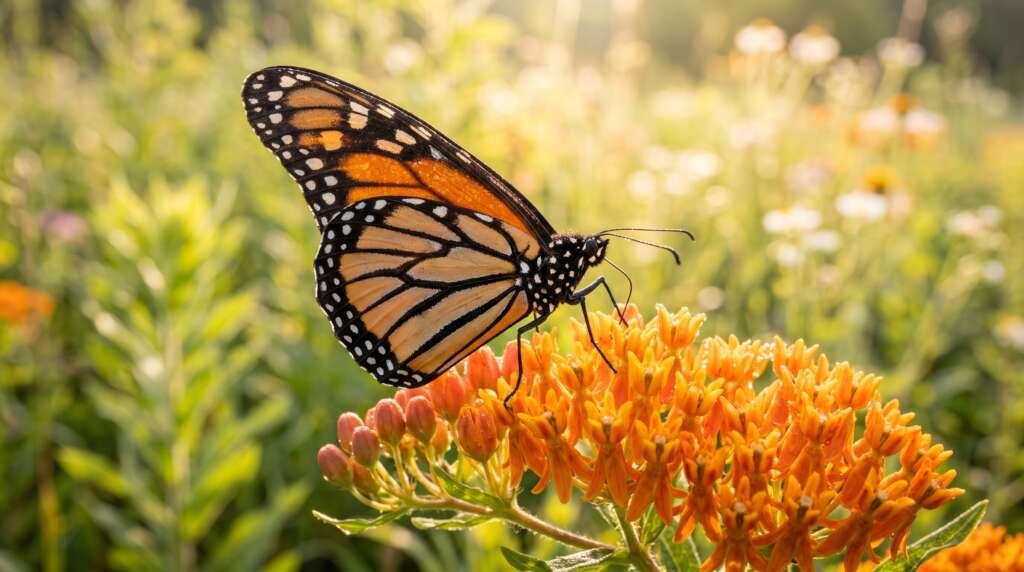
- Monarch butterflies (Danaus plexippus) migrate up to 3,000 miles from Canada to Mexico.
- Caterpillars eat only milkweed leaves and transform through 5 instar stages over 10 to 14 days.
- The IUCN lists migratory monarchs as Endangered due to habitat loss and pesticide exposure.
- Adults navigate using a sun compass and magnetic field detection during migration.
- Gardeners in USDA zones 3 through 9 attract monarchs by planting native Asclepias species.
Amazing Monarch Butterfly Facts Every Nature Lover Should Know
Monarch butterflies (Danaus plexippus) belong to the Lepidoptera order and complete the longest migration of any insect on Earth, traveling up to 3,000 miles from Canada to central Mexico across four to five generations. These butterflies rely exclusively on milkweed plants for caterpillar development and navigate using a biological sun compass combined with magnetic field detection. Their migratory population is now classified as Endangered by the IUCN due to habitat loss and pesticide exposure. Most nature enthusiasts observe monarchs without understanding the biological complexity behind their migration or the conservation threats they face. This article presents amazing monarch butterfly facts for nature lovers seeking to understand migration biology, caterpillar development, and conservation actions.
How Far Do Monarch Butterflies Migrate?
Eastern monarch butterflies travel up to 3,000 miles from southern Canada to oyamel fir forests in Mexico’s Monarch Butterfly Biosphere Reserve, one of the most critical monarch overwintering sites on Earth. Western monarchs migrate to coastal California and Baja California, traveling up to 1,000 miles. Scientists asking how many miles do monarch butterflies travel have recorded individual flight paths exceeding 3,000 miles. Researchers mapping what is the monarch butterfly migration route have identified two distinct flyways separated by the Rocky Mountains.
Monarch antennae contain cryptochrome proteins that detect Earth’s magnetic field while a circadian clock adjusts their sun compass. The monarch butterfly migration spans 4 to 5 generations. No single butterfly completes the full round trip. Diapause physiology delays reproductive development in the final migratory generation until spring arrival at breeding grounds. The longest butterfly migration on Earth requires continuous nectar corridors along the entire route. Monarchs store fat reserves in abdominal tissue to fuel the nonstop segments of this journey. Weather fronts and wind patterns influence daily flight distances during the fall migration period.
What Do Monarch Caterpillars Eat and How Do They Transform?
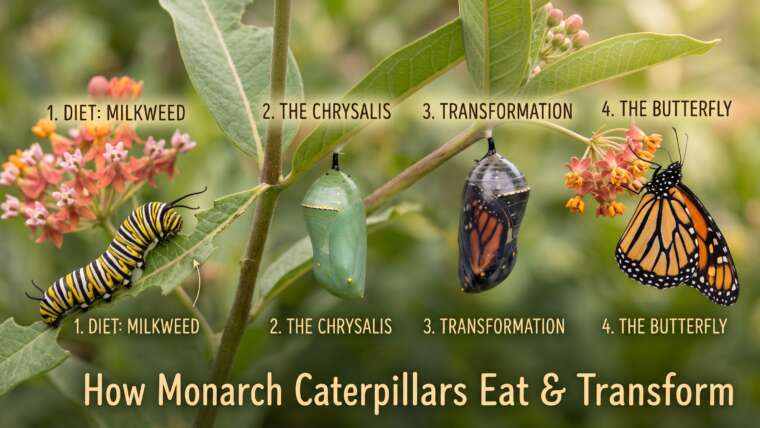
Monarch caterpillars eat only milkweed (Asclepias species), an extreme dietary specialization among herbivores explored in deeper studies of what insects eat and their feeding habits. They store cardiac glycosides that make both caterpillars and adults toxic to predators. The general butterfly life cycle from egg to adult progresses through distinct biological stages:
-
Oviposition behavior targets the underside of young milkweed leaves. Eggs hatch in 3 to 5 days.
-
First-instar caterpillars begin feeding immediately on milkweed tissue. They consume only Asclepias species throughout all monarch instar stages on this milkweed host plant.
-
The larval period lasts 10 to 14 days total. Aposematic coloration develops in later instars. Black, white, and yellow bands warn predators of toxicity through Müllerian mimicry shared with viceroy butterflies.
-
Proleg locomotion allows caterpillars to grip milkweed stems while feeding. Each instar molt increases body mass by approximately 2,000 times from first to fifth stage.
-
The monarch butterfly caterpillar turns into chrysalis within 24 hours of selecting a pupation site. The monarch chrysalis transformation lasts 8 to 15 days depending on ambient temperature.
A fifth-instar monarch caterpillar in a Michigan garden consumed an entire common milkweed leaf in 47 minutes before crawling 8 inches to the underside of a parsley stem to begin pupation. The chrysalis turned from bright green to translucent gold within 10 days, revealing folded orange wings 24 hours before the adult emerged. The monarch wing pattern of orange and black veins becomes visible through the chrysalis wall during the final 48 hours. Milkweed contains cardiac glycosides that are toxic to humans and pets if ingested. Wear gloves when handling milkweed plants and keep children away from the sap.
Why Are Monarch Butterflies Endangered?
The IUCN Red List classified the migratory monarch butterfly as Endangered in July 2022. The U.S. Fish and Wildlife Service reports that eastern monarch overwintering colonies occupied 2.83 hectares of Mexican oyamel fir forest during the 2023 to 2024 season, a 59% decline from the 1996 to 1997 baseline measurement of 6.91 hectares. Western monarch counts dropped from 1.2 million in 1997 to fewer than 2,000 in 2020.
Scientists studying why monarchs and other insects support biodiversity to keep nature in balance point to their role as pollinators and as indicators of environmental health. The monarch butterfly conservation status and threats include neonicotinoid exposure and milkweed habitat fragmentation.
| Factor | Eastern Monarch Population | Western Monarch Population |
| Overwintering location | Mexico (oyamel fir forest) | California / Baja California coast |
| Distance migrated | Up to 3,000 miles | Up to 1,000 miles |
| 2023-2024 population | 2.83 hectares | ~35,000 individuals |
| Primary threat | Agricultural pesticide drift | Coastal habitat development |
| Monitoring program | Journey North | Western Monarch Count |
Citizen science monitoring through Journey North and the Western Monarch Count tracks real-time migration and breeding data. Monarch population decline causes and solutions require coordinated butterfly conservation efforts across North America. Endangered monarch butterfly recovery depends on eliminating neonicotinoid pesticide use and restoring milkweed host plant density in breeding corridors.
How Do Monarch Butterflies Find Their Way During Migration?
Entomologists studying how do monarch butterflies find their way have identified cryptochrome proteins as the primary magnetic sensors. A circadian clock in the brain adjusts the sun compass for time of day. The monarch butterfly migration requires nectar corridors: continuous patches of blooming wildflowers along the route.
The final generation enters diapause and lives 8 to 9 months, outliving the 2 to 6 week lifespan of breeding-season adults—an exceptional survival strategy compared across typical insect lifespans in common species. This migratory generation, called the Methuselah generation, does not reproduce until spring return to breeding grounds.
Diapause physiology ensures that lipid stores last through the winter dormancy period. Monarchs navigate using a combination of polarized light detection and geomagnetic mapping that functions across multiple generations. Eastern populations target specific oyamel fir groves in Mexico at elevations above 10,000 feet. Western populations seek coastal Monterey pine and eucalyptus stands. Researchers study monarch butterfly tagging and tracking methods through the Monarch Watch program. The butterfly tagging program provides data on survival rates and flight speed.
Do Monarch Butterflies Die Immediately After Laying Eggs?
Adult monarchs live 2 to 6 weeks during the breeding season. Monarch pheromone communication facilitates mate selection during this period. The final migratory generation enters diapause and lives 8 to 9 months. This generation does not reproduce until spring return. Death timing depends on generation and environmental stress, not egg-laying behavior. The misconception that monarchs die after laying eggs likely arises from confusing Danaus plexippus with mayflies or certain moth species.
Field biologists confirm that how long do monarchs live depends entirely on whether the individual enters reproductive diapause. Summer breeding adults complete their life cycle in 14 to 40 days. The Methuselah generation survives the winter in Mexico before initiating the northward return flight. Adult Danaus plexippus reach a monarch butterfly wingspan and size of 3.5 to 4 inches.
How to Attract Monarch Butterflies to Your Garden
Gardeners in USDA zones 3 through 10 create monarch habitat through specific plant selection and maintenance practices. Welcoming monarchs alongside other beneficial garden insects strengthens natural garden resilience.
- Plant native milkweed species matched to your USDA hardiness zone. Asclepias tuberosa (butterfly weed) thrives in zones 3 to 9. Asclepias incarnata (swamp milkweed) grows in zones 3 to 9. Asclepias fascicularis (narrowleaf milkweed) suits Western zones 6 to 10.
- Include nectar-rich companion plants that bloom sequentially from spring through fall. Best plants to attract monarch butterflies include blazing star, goldenrod, and native asters. Butterfly nectar plants provide essential fuel for fall migration.
- Avoid systemic pesticides; instead, opt for non-chemical alternatives like natural garden pest control methods that preserve pollinator safety.
- Register your garden with Monarch Watch as a certified Waystation.
- Join citizen science monitoring by reporting sightings to Journey North.
Neonicotinoid pesticides persist in plant tissues for 6 to 12 months and kill caterpillars that feed on treated plants. Verify that nursery plants are neonicotinoid-free before purchase. Butterfly garden tips include clustering milkweed in groups of 6 to 12 plants rather than scattering single specimens. Gardening guides explaining how to attract monarch butterflies successfully recommend eliminating all broadcast pesticide applications within 50 feet of host plants. Gardeners wondering how to help save monarch butterflies can register their garden with Monarch Watch and report all sightings to tracking databases.
Frequently Asked Questions About Monarch Butterfly Facts
How far do monarch butterflies migrate?
Eastern monarch butterflies migrate up to 3,000 miles from Canada to Mexico. Western populations travel up to 1,000 miles to coastal California. No single butterfly completes the round trip. The journey spans 4 to 5 generations.
What do monarch caterpillars eat?
Monarch caterpillars eat only milkweed leaves (Asclepias species). They store cardiac glycosides from the plant, which makes both caterpillars and adult butterflies toxic to predators.
Why are monarch butterflies endangered?
The IUCN classifies migratory monarchs as Endangered. Primary threats include neonicotinoid pesticides, milkweed habitat loss, and climate change disrupting migration timing. Eastern populations declined 59% from 1996 baseline levels.
How long does a monarch butterfly live?
Breeding-season adult monarchs live 2 to 6 weeks. The final migratory generation enters diapause and lives 8 to 9 months, surviving the winter in Mexico before returning north to reproduce.
Where do monarch butterflies go in winter?
Eastern monarch butterflies overwinter in oyamel fir forests in central Mexico. Western monarchs overwinter in coastal California and Baja California. Both populations rely on stable, cool microclimates to survive dormancy.
Conclusion
The monarch butterfly migration represents one of the most complex navigational feats in the animal kingdom. Your garden choices directly influence whether future generations complete this 3,000-mile journey.
Understanding monarch biology transforms casual observation into informed conservation action. Each milkweed planting in USDA zones 3 through 10 contributes to nectar corridors that sustain the migration. Citizen scientists who report sightings to Journey North provide data that shapes federal conservation policy. Share your monarch sighting in the comments below and tell us which native milkweed species grows in your region.