
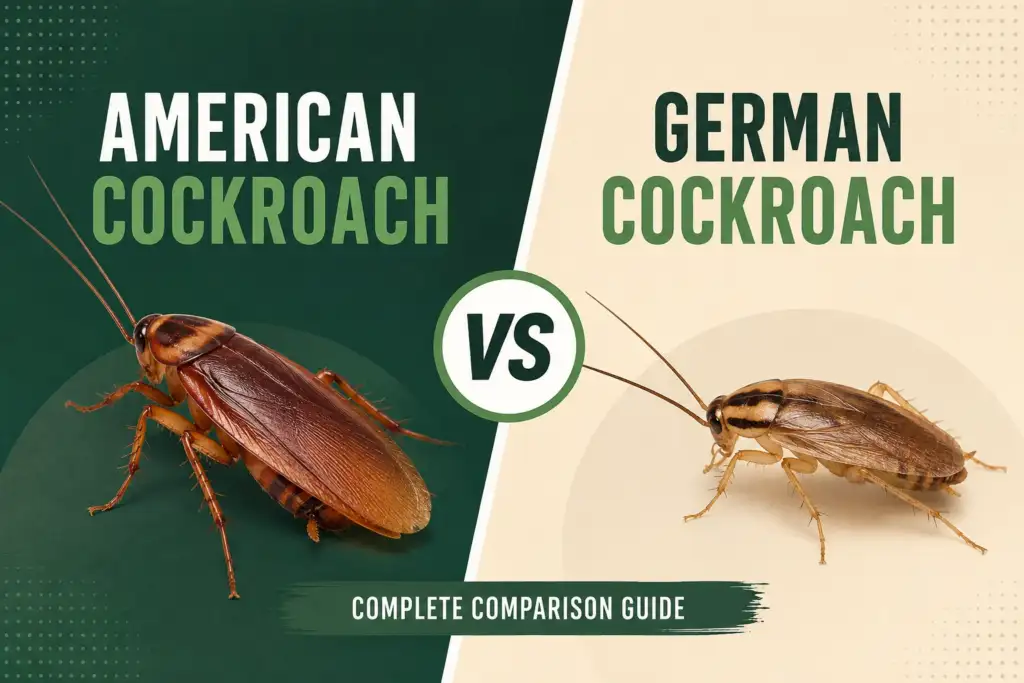
- German cockroaches measure 13 to 16 millimeters with two dark stripes on the pronotum.
- American cockroaches reach 38 to 53 millimeters with a yellow figure-eight pattern.
- German cockroaches infest kitchens and bathrooms. American cockroaches live in sewers and drains.
- One female German cockroach produces 30,000 offspring yearly under optimal conditions.
- Gel baits treat German cockroaches. Sealing entry points treats American cockroaches.
American cockroaches (Periplaneta americana) grow up to 2 inches long and prefer damp outdoor environments. German cockroaches (Blattella germanica) measure roughly 0.5 inches, display two dark stripes behind the head, and infest kitchens and bathrooms indoors. Size and habitat differences determine which treatment method eliminates each species.
Misidentification leads homeowners to apply the wrong bait or spray, which wastes money and allows the infestation to expand. Homeowners in the southern United States face both species simultaneously and need targeted strategies for each.
Readers gain exact cockroach types and identification, behavioral patterns, and species-specific treatment protocols to tell German from American roaches and act immediately.
How to Tell German From American Roaches
German cockroaches measure 13 to 16 millimeters in length. American cockroaches reach 38 to 53 millimeters. The size gap makes initial identification straightforward in side-by-side comparison.
German cockroaches display two parallel dark stripes on the pronotum. American cockroaches show a yellowish figure-eight pattern on the pronotum. These pronotum markings provide the fastest visual identification method.
German cockroaches are light brown to tan. American cockroaches are reddish-brown with a yellow margin on the pronotum. Color differences become visible under standard kitchen lighting.
Both species have wings, but German cockroaches rarely fly. American cockroaches glide short distances in warm, humid conditions. Flight behavior differs significantly between the two species.
Baby German cockroaches, called nymphs, display the same two dark stripes during early instars. Baby American cockroaches are grayish-brown and wingless during early instars. Nymph identification prevents misdiagnosis of mixed infestations.
At 11 PM in Tampa, Florida, a German cockroach scurried from behind a microwave. The specimen measured 15 millimeters and showed two distinct dark stripes on the pronotum. A 45-millimeter American cockroach appeared in the same home’s basement with a yellowish figure-eight pattern. The size and marking differences were visible without magnification.
| Feature | German Cockroach | American Cockroach |
| Size | 13-16 mm (half inch long) | 38-53 mm (two inches long) |
| Color | Light brown to tan | Reddish-brown |
| Pronotum Marking | Two dark stripes | Yellow figure-eight pattern |
| Wings | Rarely fly | Glide short distances |
| Nymph Appearance | Two dark stripes visible | Grayish-brown, wingless |
What Does a German Cockroach Look Like?
A German cockroach looks like a light brown oval measuring 13 to 16 millimeters. Two dark longitudinal stripes run the length of the pronotum. The antennae are long and thin relative to the body size.
How Big Is an American Cockroach?
An American cockroach measures 38 to 53 millimeters in length. The body is reddish-brown with long antennae that extend beyond the abdomen. The yellowish figure-eight pattern on the pronotum distinguishes adults from other large roaches.
Where German Cockroaches Hide vs Where American Roaches Enter
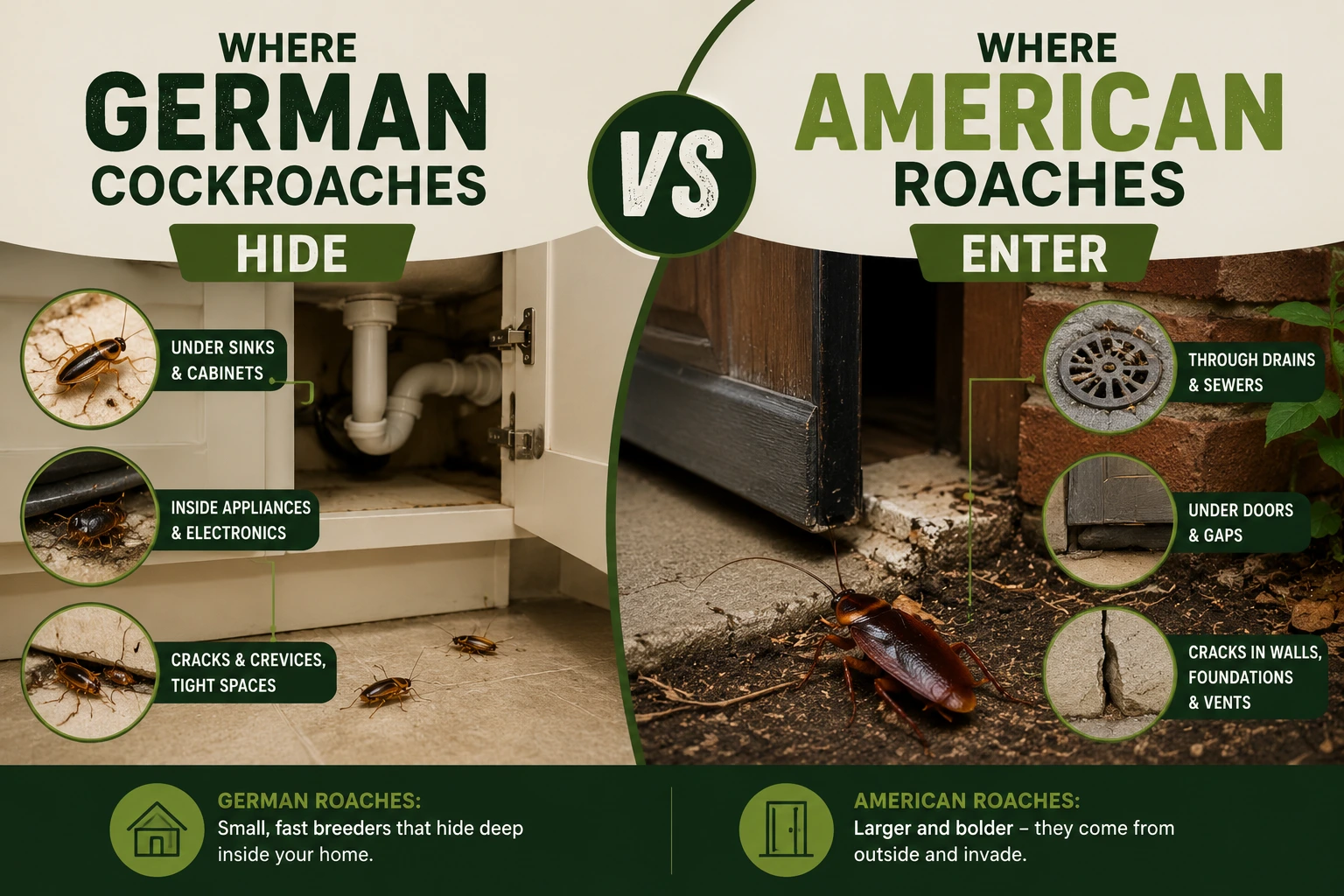
German cockroaches prefer warm, humid indoor locations near food and water. Kitchens, bathrooms, and appliance motors provide ideal harborage. A single German cockroach sighting in a kitchen indicates an established indoor population.
American cockroaches are peridomestic pests. They live in sewers, drains, mulch beds, and woodpiles, then enter structures through pipes and foundation cracks. American roaches come from outdoor harborage areas and migrate indoors during temperature extremes.
German cockroaches spread through shared walls in apartment buildings and via used appliances or grocery bags. American cockroaches appear in basements, crawl spaces, and laundry rooms during temperature extremes. The indoor vs outdoor habitat split determines where inspectors find each species.
An American cockroach in a bathroom signals an exterior entry point. German cockroaches use drain routes less frequently than American species. Understanding where each species enters prevents wasted treatment efforts. See our guide to crawling insects in the home for more information on hidden pest activity.
Kitchen and Bathroom Hotspots
German cockroaches cluster behind refrigerators, under sinks, and inside microwave motors. American cockroaches rarely nest in these spots unless plumbing leaks create excessive moisture. Kitchen and bathroom harborage defines German cockroach territory.
Basement and Drain Entry Points
Floor drains, sewer cleanouts, and foundation gaps serve as American cockroach highways. German cockroaches use these routes less frequently. Basement and drain inspections reveal American cockroach entry paths where outdoor populations access the structure.
How Fast Do German Roaches Multiply Compared to American Roaches?
A female German cockroach produces an ootheca containing 30 to 40 eggs every 4 to 6 weeks. She carries the egg case until 24 hours before hatching. The ootheca remains attached to her abdomen for the entire incubation period.
A female American cockroach produces an ootheca containing 14 to 16 eggs every 6 to 8 weeks. She deposits the egg case in a sheltered location within 48 hours of formation. The female does not carry the ootheca.
German cockroach eggs hatch in 28 days at room temperature. American cockroach eggs hatch in 44 to 62 days. Faster hatch times accelerate German cockroach population growth.
German cockroach nymphs reach maturity in 36 to 100 days. American cockroach nymphs require 150 to 400 days to mature. Shorter development cycles explain why German cockroach infestations escalate within 60 days.
The National Pest Management Association reports that one female German cockroach and her offspring produce 30,000 individuals in one year under optimal conditions. This rapid reproduction rate overwhelms DIY treatments that target only visible adults. Professional pest control becomes necessary when egg cases remain protected inside wall voids.
| Feature | German Cockroach | American Cockroach |
| Eggs per ootheca | 30-40 | 14-16 |
| Ootheca production interval | Every 4-6 weeks | Every 6-8 weeks |
| Egg incubation period | 28 days | 44-62 days |
| Nymph maturity time | 36-100 days | 150-400 days |
German Roach Eggs Look Like
German roach eggs look like a light brown capsule measuring 7 to 9 millimeters long. The ootheca is slightly curved and protrudes from the female’s abdomen. The female carries the cockroach egg case until 24 hours before hatching.
Can You Have Both American and German Roaches at the Same Time?
Homes in the southern United States can harbor both species simultaneously. American cockroaches occupy outdoor-connected areas while German cockroaches dominate indoor food prep zones. German and American cockroaches live together in the same structure without direct competition because they occupy different ecological niches.
Both species require different treatment strategies. Bait stations effective against German cockroaches often fail against American cockroaches due to size and feeding behavior differences. American cockroaches consume decaying organic matter. German cockroaches prefer starchy, sugary, and protein-based human foods.
Seeing large reddish-brown roaches in the basement and small tan roaches in the kitchen confirms a dual infestation. An American roach in the house combined with a German cockroach infestation in an apartment kitchen signals separate entry points and food sources. Treating only one species leaves the other population intact. Integrated pest management addresses both simultaneously through sanitation and moisture control.
Best Treatment for German vs American Roaches
German cockroach infestations respond best to gel baits placed in crack and crevice treatment zones. Insect growth regulators (IGRs) prevent nymphs from reaching reproductive maturity. IGRs disrupt the molting process and stop population expansion.
American cockroach control requires sealing exterior entry points first. Perimeter sprays and granular baits in mulch beds target outdoor harborage. Foundation gaps and pipe penetrations need caulk or steel wool barriers.
German cockroaches develop bait aversion to certain glucose formulations. Rotation between bait active ingredients prevents resistance. Monthly bait rotation maintains efficacy in heavy infestations.
American cockroaches in drains benefit from drain covers and enzymatic cleaners that remove organic film. Drain cleaning eliminates the food source that attracts peridomestic populations. Drain covers block adult entry when installed on floor drains and sewer cleanouts.
The best way to kill roaches depends on species identification. Gel baits in 10 to 15 kitchen locations get rid of German roaches fast. Cockroach pest control providers must identify the species before selecting baits.
DIY roach treatment eliminates light infestations. Professional extermination costs $100 to $400 for German cockroaches and $150 to $500 for American cockroach perimeter programs. Severe German infestations require heat treatment or fumigation at $1,200 to $2,500. Homeowners who search cockroach control near me must select providers that identify species before treatment.
All pesticide applications must follow EPA label instructions. Baits must stay away from food preparation surfaces and out of reach of children and pets. Misuse of insect growth regulators in food-handling establishments violates FDA regulations.
DIY Roach Treatment vs Professional Help
Light German infestations with under 10 visible roaches per night respond to over-the-counter gel baits. Heavy infestations require professional heat treatment or fumigation. DIY roach treatment works for American cockroaches only when homeowners seal all entry points first.
Professional extermination cost varies by infestation severity and square footage. German cockroach treatments average $150 per follow-up visit. American cockroach perimeter programs require quarterly maintenance at $100 to $150 per visit.
Frequently Asked Questions About American vs German Cockroaches
Why are German cockroaches so hard to kill?
German cockroaches reproduce rapidly, carry eggs until hatching, and develop bait aversion. One female produces 30,000 offspring yearly under optimal conditions. Their small size allows harborage inside appliance motors and wall voids that sprays cannot reach.
Is a palmetto bug an American cockroach?
Palmetto bug is a common name for the American cockroach in the southeastern United States. The same species (Periplaneta americana) grows up to 2 inches and displays a yellowish figure-eight pattern on the pronotum. The term causes confusion among homeowners who do not recognize the scientific name.
How long do American cockroaches live indoors?
American cockroaches live 12 to 18 months indoors when moisture and food remain available. Nymphs mature in 150 to 400 days. Adults survive 2 to 3 months without food but die within 1 week without water.
What attracts American cockroaches to your house?
American cockroaches enter houses through sewer lines, foundation cracks, and drain pipes. Decaying organic matter, plumbing leaks, and outdoor mulch beds near foundations attract them. Warm, humid basements provide ideal indoor harborage.
Do American cockroaches come up from drains?
American cockroaches enter homes through floor drains, sewer cleanouts, and broken pipes. German cockroaches use drains less frequently. Drain covers and enzymatic cleaners block this entry route.
Conclusion
German cockroaches demand immediate indoor bait and IGR treatment because their rapid reproduction rate converts small infestations into severe outbreaks within 60 days. American cockroach control starts with sealing exterior entry points and reducing outdoor moisture. Delayed treatment allows vector-borne bacteria including Salmonella and E. coli to contaminate food preparation surfaces.
Correct identification saves hundreds of dollars in ineffective treatments and prevents health risks from prolonged infestation. Cockroach debris causes allergen sensitization that triggers asthma attacks in sensitive individuals. Homeowners who spot roaches in the kitchen or basement can act immediately with species-specific protocols instead of guessing. Our bug identification can help with identification.
If you spot roaches in your kitchen or basement, contact a licensed pest control professional for a free species identification and customized treatment plan.