
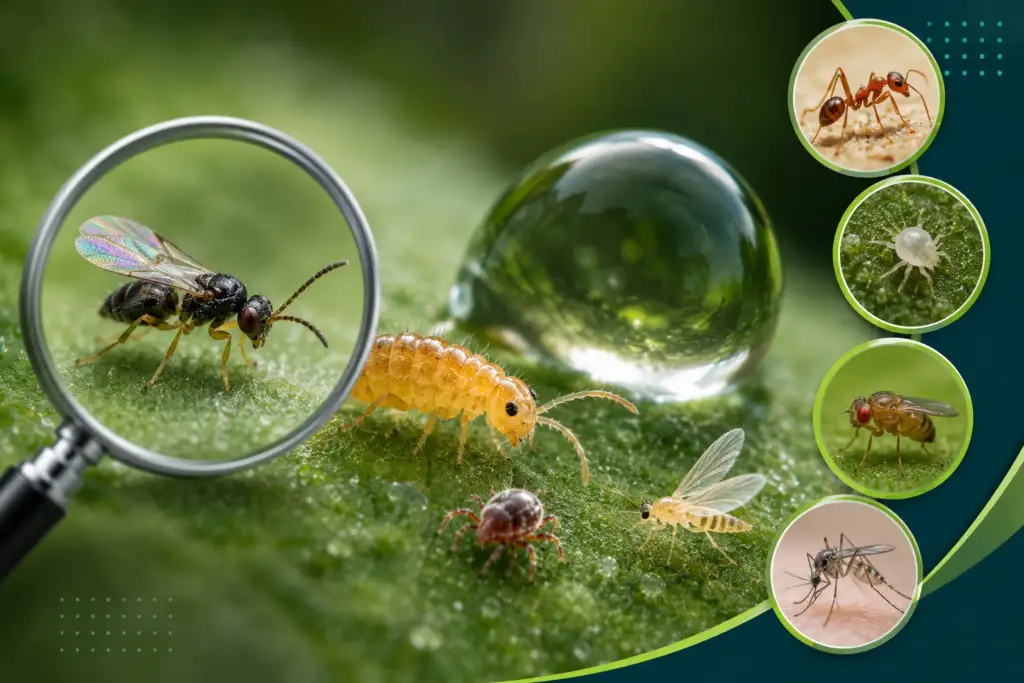
- Dicopomorpha echmepterygis, a fairyfly in the Mymaridae family, holds the record at 0.139 millimeters.
- These egg parasitoids control agricultural pests by laying eggs inside host insect eggs.
- Seven species measure under 0.5 millimeters, including featherwing beetles and phorid flies.
- Their decline in temperate agricultural zones threatens integrated pest management systems.
- Compound microscopes at 100x magnification are required to observe them.
The smallest insects on Earth are so tiny that many are invisible to the naked eye. Some measure less than 0.2 millimeters, yet they perform important ecological functions, including parasitizing pest eggs, recycling nutrients, and supporting natural pest-control systems.
The smallest known insect is the fairyfly Dicopomorpha echmepterygis, which measures approximately 0.139 millimeters in body length. This microscopic wasp belongs to the Mymaridae family and develops as an egg parasitoid inside the eggs of other insects.
Understanding these tiny insects provides a different perspective on biodiversity. While people often notice spectacular insects such as butterflies, beetles, and giant moths, many of the most important ecological interactions occur at a microscopic scale. For comparison, you can also explore our guide to the biggest insects in the world to see just how dramatically insect body sizes can vary.
In this guide, we will examine the seven smallest insects, explain how insects survive at microscopic sizes, and explore why these tiny organisms matter to ecosystems and agriculture.
What Is the Smallest Insect on Earth?
Dicopomorpha echmepterygis is recognized as one of the smallest known insects, with a recorded body length of approximately 0.139 millimeters.
This species is a fairyfly, a group of extremely small parasitic wasps in the Mymaridae family. Fairyflies do not behave like the large wasps people commonly imagine. Instead, females search for the eggs of other insects and insert their own eggs inside them.
The developing larva consumes the host egg from within.
The species was described from specimens collected in Arizona, and its microscopic size places it near the extreme lower boundary of insect body size.
The Anatomy of a Microscopic Wasp
Extreme miniaturization produces unusual anatomical features.
Female fairyflies have delicate wings fringed with long hairs. These fringes help them move through air at a microscopic scale. Males of some fairyfly species can be wingless and have highly reduced sensory and feeding structures.
Their tiny bodies also leave little room for organs that larger insects possess in greater proportions. Reproductive structures can occupy a substantial portion of the abdomen, while digestive and sensory systems become highly compressed.
This is one reason microscopic insects are so difficult to study. Researchers generally need microscopes and specialized collection techniques to examine them properly.
How Do Insects Survive at Microscopic Sizes?
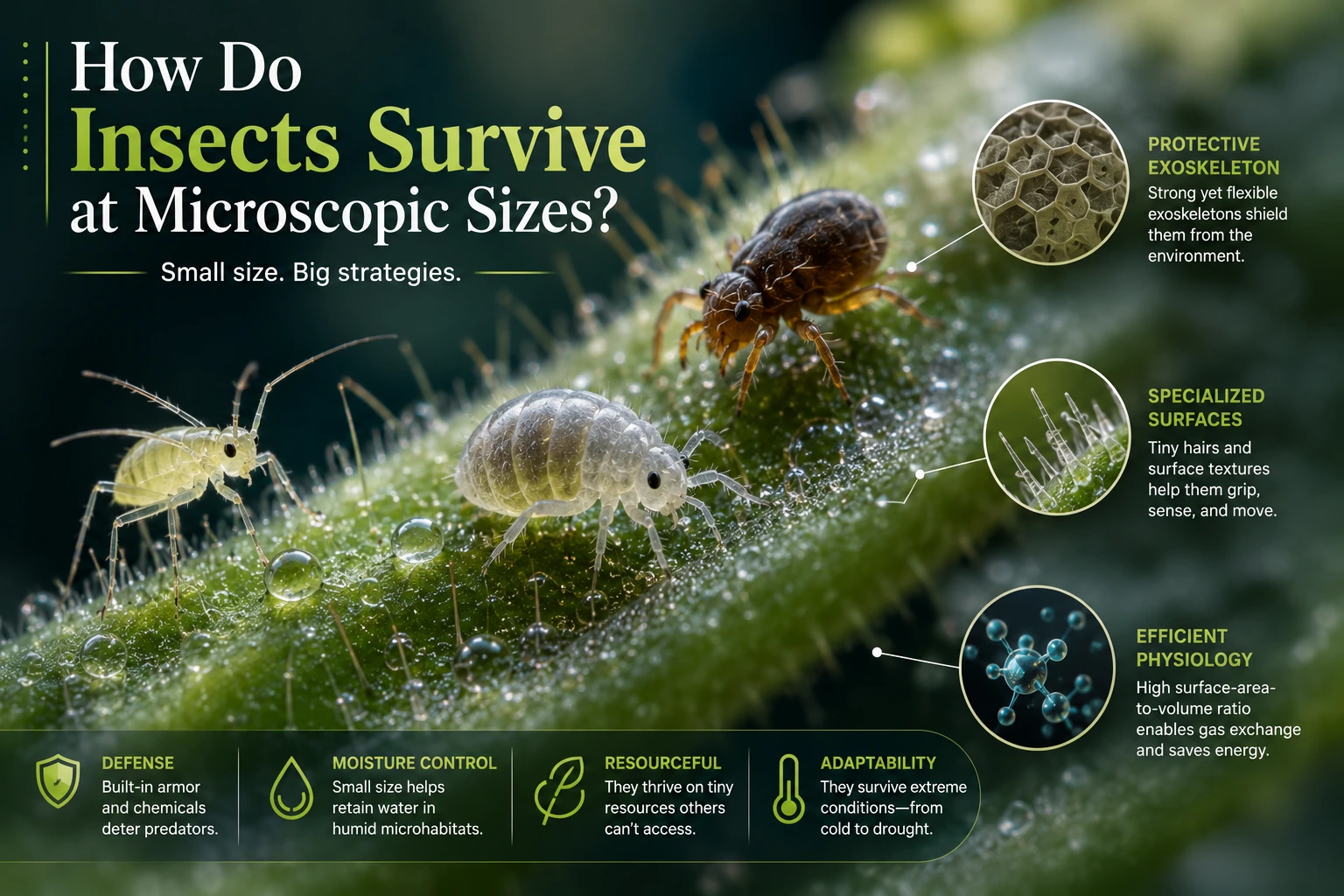
Insect miniaturization requires major changes in anatomy, development, respiration, and movement.
1. Compact Body Design
As insects become smaller, their bodies cannot simply be scaled down proportionally in every respect. Internal structures must become highly compact while still performing essential functions.
The result is an insect body designed around efficiency.
2. Reduced or Simplified Organs
Some microscopic insects have highly reduced eyes, mouthparts, digestive structures, or other organs.
These reductions can save space and energy.
In some fairyfly males, for example, feeding structures may be extremely reduced because adults have very short lifespans and devote their limited energy primarily to reproduction.
3. Efficient Respiration
Respiration also becomes increasingly challenging at extremely small body sizes.
Insects use tracheal systems to transport oxygen. At microscopic scales, diffusion can become increasingly important because oxygen has a very short distance to travel through the body.
4. Compressed Nervous Systems
Tiny insects also demonstrate remarkable nervous-system efficiency.
Some miniature parasitoid wasps possess extraordinarily small nervous systems while still being capable of locating hosts, navigating their environment, mating, and reproducing.
5. Fringed Wings and Low-Reynolds-Number Flight
Microscopic flying insects operate in a very different physical environment from large birds or even ordinary-sized insects.
Their fringed wings interact strongly with air viscosity. Instead of relying entirely on conventional aerodynamic lift, their wings can function more like paddles moving through a viscous medium.
6. Surface Tension Becomes Important
At microscopic scales, surface tension can become a major physical force.
A tiny water droplet can behave almost like an obstacle or trap. This means that insects living at microscopic scales must navigate physical forces that are insignificant to larger animals.
7 Smallest Insects Ranked by Size
The following species represent some of the smallest insects documented in the scientific literature and taxonomic records.
| Rank | Species | Order | Approx. Size | Ecological Role |
|---|---|---|---|---|
| 1 | Dicopomorpha echmepterygis | Hymenoptera | 0.139 mm | Egg parasitoid |
| 2 | Kikiki huna | Hymenoptera | 0.150 mm | Egg parasitoid |
| 3 | Megaphragma caribea | Hymenoptera | 0.170 mm | Egg parasitoid |
| 4 | Dicopomorpha sp. | Hymenoptera | ~0.180 mm | Egg parasitoid |
| 5 | Tinkerbella nana | Hymenoptera | 0.250 mm | Egg parasitoid |
| 6 | Scydosella musawasensis | Coleoptera | 0.325 mm | Fungal spore feeder |
| 7 | Euryplatea nanaknihali | Diptera | 0.400 mm | Ant-associated parasitoid |
These measurements demonstrate how dramatically insect size can vary. At the other extreme, some insects can reach several inches in length or wingspan; our guide to the biggest insects in the world covers those record-breaking species.
What Makes Each Tiny Insect Unique?
1. Dicopomorpha echmepterygis
At approximately 0.139 millimeters, Dicopomorpha echmepterygis represents the extreme end of insect miniaturization.
It is an egg parasitoid, meaning its offspring develop inside the eggs of other insects.
2. Kikiki huna
Kikiki huna is another exceptionally small fairyfly, measuring around 0.150 millimeters.
Its size makes it difficult to observe without specialized optical equipment. Like other fairyflies, it is associated with insect eggs and participates in natural biological-control interactions.
3. Megaphragma caribea
Megaphragma caribea is another miniature parasitoid wasp famous for its extremely small nervous system.
Its biology illustrates how natural selection can produce highly compact solutions for movement, sensing, and reproduction.
4. Dicopomorpha sp.
Some undescribed or incompletely characterized Dicopomorpha specimens are also extremely small.
Discoveries like these demonstrate why leaf litter, soil, and other seemingly ordinary habitats can contain insect diversity that is difficult to detect during conventional field surveys.
5. Tinkerbella nana
Tinkerbella nana received its memorable name because of its exceptionally small size and fairy-like appearance.
Like other fairyflies, it belongs to the parasitoid wasp group and lives at a scale that makes ordinary field observation nearly impossible.
6. Scydosella musawasensis
Scydosella musawasensis is especially interesting because it is a tiny beetle rather than a parasitoid wasp.
It feeds on fungal material and represents an example of how miniature insects can occupy ecological roles completely different from those of fairyflies.
7. Euryplatea nanaknihali
Euryplatea nanaknihali is a tiny phorid fly associated with ants.
Its unusual biology demonstrates that extreme miniaturization is not limited to wasps. Tiny flies and beetles can also evolve highly specialized lifestyles.
How Scientists Find the Smallest Insects
Finding a 0.139-millimeter insect in nature is considerably more difficult than finding a butterfly or beetle.
Researchers may collect leaf litter, soil, decomposing vegetation, or other substrate where microscopic insects live.
Specialized extraction methods can separate insects from collected material. Researchers then use stereomicroscopes or compound microscopes to identify and examine specimens.
At higher magnification, features that appear invisible to the naked eye—including antennae, wing fringes, body segmentation, and reproductive structures—become visible.
For people interested in learning how insect identification works more generally, our guide to everything you need to know about bug identification explains how body shape, legs, wings, antennae, color, size, habitat, and behavior can help distinguish insects. The guide also emphasizes that accurate identification helps people distinguish beneficial insects from pests.
How Fairy Wasps Protect Crops
One of the most important features of fairyflies is their role as parasitoids.
Female fairy wasps locate the eggs of suitable host insects and deposit their own eggs inside them. The developing larvae then consume the contents of the host egg.
This makes egg parasitoids potentially valuable components of biological pest management.
Instead of applying a broad-spectrum chemical treatment, biological control uses natural enemies to suppress pest populations.
This is part of a larger ecological process in which predators and parasitoids help regulate insect populations.
The Crawlix guide to beneficial garden insects and natural plant protection explains the broader categories of beneficial insects, including predators, parasitoids, and pollinators.
Integrated Pest Management
Integrated Pest Management, or IPM, combines monitoring, prevention, biological controls, and carefully selected treatments.
Tiny parasitoids can contribute to this strategy because they target specific host insects rather than indiscriminately affecting every insect in an environment.
This specificity is important.
A healthy ecosystem contains both insects that people consider pests and insects that naturally suppress those pests. Eliminating all insects can therefore remove important ecological relationships.
Why Tiny Insects Matter to Biodiversity
Insects are not simply pests. They perform numerous ecological functions, including pollination, decomposition, predation, parasitism, and serving as food for other animals.
The Crawlix article on how insects support biodiversity and keep nature in balance describes insects as important contributors to pollination, nutrient recycling, natural pest control, and food webs.
Tiny parasitoids fit into this larger system by helping regulate populations of other insects.
The Cascading Effects of Insect Loss
When natural enemies disappear, pest populations can increase.
Farmers and gardeners may then rely more heavily on pesticides, which can affect additional species.
This can create a cycle:
Loss of beneficial insects → pest increase → greater pesticide use → further loss of beneficial insects.
Protecting insect diversity can therefore help preserve ecological balance.
Why Invisible Insects Face Major Threats
Microscopic insects face many of the same pressures as larger insects, but their small size can make their decline difficult to detect.
Important threats include:
- Habitat destruction and fragmentation
- Pesticide exposure
- Loss of host species
- Changes in temperature and seasonal timing
- Agricultural intensification
- Declining plant and insect diversity
For highly specialized parasitoids, the loss of a host insect can effectively eliminate the habitat required for reproduction.
A species may therefore disappear even when its habitat appears intact to humans.
Tiny Insects and the Food Web
Small insects can occupy surprisingly important positions in food webs.
They may:
- Control herbivorous insects
- Transfer energy to larger predators
- Break down organic material
- Consume fungi and microorganisms
- Pollinate plants
- Serve as hosts or prey for other organisms
Their ecological importance is therefore not determined by body size.
An insect measuring less than one millimeter can influence processes that eventually affect plants, soil organisms, birds, mammals, and agricultural production.
Common Myths About the Smallest Insects
Myth 1: The smallest insects are just baby insects.
Fact: Tiny insect species are not simply juvenile versions of larger insects. They are distinct species with their own life cycles and adaptations.
Myth 2: Fairyflies are dangerous to people.
Fact: Fairyflies are specialized parasitoids that target insect eggs. Their biology is fundamentally different from that of wasps that sting humans.
Myth 3: All tiny insects are parasites.
Fact: Not all miniature insects are parasitoids. Tiny beetles such as Scydosella musawasensis have different feeding strategies and ecological roles.
Myth 4: A normal magnifying glass is enough to see the smallest insects.
Fact: Many of the smallest insects require substantially greater magnification. Their anatomy is difficult or impossible to examine accurately without microscopy.
Frequently Asked Questions About the Smallest Insects on Earth
What is the smallest insect on Earth?
Dicopomorpha echmepterygis is widely recognized as the smallest known insect, with a recorded body length of approximately 0.139 millimeters.
What is the smallest flying insect?
Kikiki huna, at approximately 0.150 millimeters, is one of the smallest known flying insects.
What do fairyflies eat?
Adult fairyflies have highly reduced feeding structures and very short adult lifespans. Their larvae develop inside host insect eggs and consume the contents of those eggs.
How do fairy wasps control crop pests?
Female fairy wasps lay eggs inside the eggs of suitable host insects. The parasitoid larvae develop within the host egg, preventing the pest insect from completing its development.
Can humans see the smallest insects?
The smallest insects are extremely difficult to see without magnification. Microscopes are generally required to examine their anatomy reliably.
Why are tiny insects important?
Tiny insects contribute to biological control, food webs, decomposition, nutrient cycling, and other ecosystem processes. Their ecological role can be much larger than their physical size suggests.
Are all small insects harmful?
No. Many small insects are beneficial or ecologically important. Correct identification is essential before deciding whether an insect should be removed or controlled. Our bug identification guide provides a useful starting point for distinguishing different insect groups.
How the Smallest Insects Compare With Other Insects
The insect world contains an extraordinary range of body sizes.
At one extreme are microscopic fairyflies measuring fractions of a millimeter. At the other are giant beetles, moths, stick insects, and other species that can reach several inches.
This contrast highlights the remarkable adaptability of insects.
The largest insects rely on different anatomical solutions for supporting large bodies, while the smallest insects must solve problems involving cellular space, respiration, movement, and reproduction.
If you want to explore the opposite end of the size spectrum, read Meet the Biggest Insects in the World, which covers record-holding insects by body length, wingspan, and mass.
Conclusion
The fairyfly and its microscopic relatives operate as invisible infrastructure for global agriculture. Their 0.139-millimeter bodies prevent billions of dollars in crop damage annually. These organisms demonstrate that biological complexity does not require physical magnitude. Entire industries depend on processes executed by animals smaller than a grain of salt.
Understanding these insects transforms how humans perceive biodiversity and food security. The smallest insects on Earth reveal hidden dependencies within agricultural systems. Their decline in temperate zones signals broader ecological instability before visible symptoms appear. Conservation efforts must expand to include organisms that lack charisma but deliver critical ecosystem functions.
Microscopic parasitoids represent the front line of sustainable agriculture. Share the smallest insect you have encountered and whether you knew invisible wasps protect the food supply.