
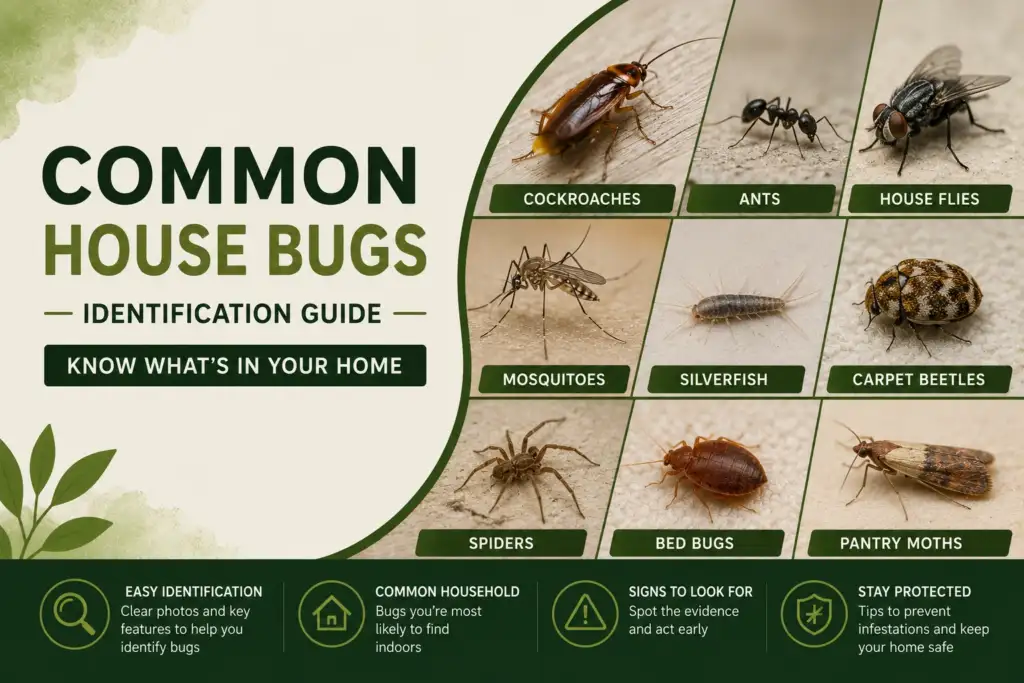
- 25 species covered with size, color, and habitat data
- Bite risk flagged for 8 species
- Infestation signs listed by pest type
- Prevention steps ranked by IPM priority
- Professional threshold defined for 5 high-risk species
Twenty-five arthropod species regularly inhabit US homes. Each species displays distinct morphological markers, preferred microhabitats, and specific health or structural risks that homeowners must recognize to act before infestation escalates. These common house bugs range from harmless pantry moths to medically significant spiders.
Bugs in house environments display size ranges from 1.5 to 53 millimeters. Homeowners waste money on misidentified pests because bug identification with pictures online lacks scale, regional context, or behavioral detail. This guide provides exact size ranges, color patterns, geographic prevalence, and bite-or-sting risk so you identify the correct pest in under 60 seconds.
How to Identify Common House Bugs (The Complete List)
Bugs in house environments require accurate identification. Homeowners identify house insects faster using size, color, and habitat data than using photographs alone.
What do house bugs look like? These types of house insects occupy distinct ecological niches. Bugs by region vary in prevalence.
The following 25 bugs found in houses provide a complete reference for household entomology, insect morphology and anatomy, and arthropod species identification.
- German cockroaches (Blattella germanica) measure 13 to 16 millimeters. Tan bodies display two dark pronotal stripes. Mandibulate mouthparts chew debris in kitchen appliances. These common bugs in homes produce 6 to 8 oothecae per female lifetime and rank as allergen-producing insects that trigger asthma in sensitized children.
- American cockroaches (Periplaneta americana) reach 38 to 53 millimeters. Reddish-brown exoskeletons bear a yellow pronotal margin. This species inhabits warm boiler rooms and sewers. American cockroaches transport 22 bacterial species. For a direct comparison between these two cockroach species, see American cockroach vs. German cockroach.
- Bed bugs (Cimex lectularius) measure 5 to 7 millimeters. Oval, reddish-brown bodies flatten to enter mattress seams. These hemimetabolous insects undergo five nymphal instars before adulthood. Nocturnal feeding produces linear 3-bite clusters For more information, see bed bug signs, symptoms, and hiding spots.
- Black widows (Latrodectus hesperus in the West, L. mactans in the East) grow 8 to 10 millimeters. Glossy black females display a red ventral hourglass. Irregular cobwebs occupy garages and woodpiles. Latrodectism causes muscle cramps within 1 to 3 hours.
- Brown recluses (Loxosceles reclusa) span 6 to 10 millimeters. Tan cephalothoraxes carry a dark violin marking. This dangerous house bug inhabits the central and southern United States from Nebraska to Georgia. Loxoscelism produces necrotic lesions within 72 hours.
- Carpenter ants (Camponotus spp.) range from 6 to 13 millimeters. Black or bicolored bodies display a single-node petiole. These structural pests excavate galleries in water-damaged wood. Satellite colonies hold 3,000 to 10,000 workers. For more identification details, see carpenter ant identification and signs.
- House crickets (Acheta domesticus) measure 16 to 21 millimeters. Tan coloration and long antennae distinguish this species. Mandibulate mouthparts chew fabric and wallpaper. Males produce 4 to 5 kilohertz calling songs.
- Silverfish (Lepisma saccharina) reach 13 to 25 millimeters. Silver-gray bodies taper to three caudal appendages. These moisture-loving insects consume cellulose in books and wallpaper. Silverfish prefer temperatures of 70 to 80 degrees Fahrenheit.
- Fire ants (Solenopsis invicta) present as 2 to 6 millimeter workers. Reddish-brown bodies display a two-segmented petiole. Southeastern US lawns host mounds of 100,000 to 500,000 individuals. Stings produce pustules within 24 hours.
- Eastern subterranean termites (Reticulitermes flavipes) produce 4 to 6 millimeter workers. Creamy white bodies and straight antennae distinguish termites from ants. Mud tubes span foundation walls. Colonies contain 60,000 to 1 million individuals.
- Cat fleas (Ctenocephalides felis) measure 1.5 to 3.3 millimeters. Dark brown, laterally compressed bodies navigate carpet fibers. Fleas bite ankles in random clusters. Females lay 20 to 50 eggs daily.
- Northern house mosquitoes (Culex pipiens) span 4 to 6 millimeters. Gray bodies display white abdominal stripes. Females pierce skin with a proboscis for blood meals. Culex species transmit West Nile virus, which caused 1,126 neuroinvasive US cases in 2023 per CDC data. For additional information, see mosquito life cycle.
- Black-legged ticks (Ixodes scapularis) measure 3 to 5 millimeters unfed. Black legs and an orange-red body distinguish adults. These nocturnal household pests quest in leaf litter near homes. I. scapularis transmits Borrelia burgdorferi, causing 30,000 to 40,000 reported Lyme disease cases annually.
- Kissing bugs (Triatoma sanguisuga) grow 14 to 24 millimeters. Dark brown bodies display red lateral abdominal stripes. Nocturnal feeding around facial skin transmits Trypanosoma cruzi. These bugs that are dangerous to humans range from Texas to Florida.
- Drain flies (Psychoda alternata) measure 1.5 to 5 millimeters. Gray, hairy wings form a roof-like posture. Larvae develop in drain biofilm and indicate plumbing maintenance needs.
- Common fruit flies (Drosophila melanogaster) reach 2.5 to 4 millimeters. Tan bodies and red eyes identify this species. Females deposit 500 to 2,000 eggs on fermenting fruit. Generations complete in 8 to 14 days at 77 degrees Fahrenheit.
- House flies (Musca domestica) measure 6 to 7 millimeters. Gray thoraxes carry four dark stripes. Sponging mouthparts lap liquid food and females produce 150 to 200 eggs per batch.
- Boxelder bugs (Boisea trivittata) span 10 to 14 millimeters. Black bodies bear red or orange wing markings. Fall aggregations cluster on south-facing walls. These seasonal bugs by state concentrate in the Midwest and Northeast.
- Brown marmorated stink bugs (Halyomorpha halys) measure 12 to 17 millimeters. Shield-shaped, mottled brown bodies release an acrid odor when disturbed. Fall migrants enter attics and wall voids. This invasive species damages crops in 46 states. For related insect information, see insects that support biodiversity and keep nature in balance.
- Webbing clothes moths (Tineola bisselliella) present as 5 to 8 millimeter golden adults. Narrow, fringed wings distinguish them from pantry moths. Larvae consume keratin in wool and silk. T. bisselliella infests stored woolens in climate-controlled closets with zero food residue.
- Indian meal moths (Plodia interpunctella) span 8 to 10 millimeters. Copper bands cover the outer third of gray forewings. Larvae spin silk in pantry corners. Females deposit 100 to 300 eggs during a 5- to 25-day lifespan.
- Varied carpet beetles (Anthrenus verbasci) measure 2 to 3 millimeters. Round bodies display a sclerotized exoskeleton with patterned scales. Larvae feed on natural fibers and pet hair. Adults enter through spring windows.
- Confused flour beetles (Tribolium confusum) reach 3 to 4 millimeters. Reddish-brown bodies possess a sclerotized exoskeleton and gradually thickening antennae. These pantry pests infest flour and cereal. Females live 1 to 2 years and produce 300 to 500 eggs.
- Rice weevils (Sitophilus oryzae) measure 2.5 to 3.5 millimeters. Dark brown bodies feature an elongated rostrum with mandibulate mouthparts at the tip. Adults bore into whole grains and leave 1-millimeter exit holes. Females lay 300 to 400 eggs inside kernels.
- Common house spiders (Parasteatoda tepidariorum) span 4 to 8 millimeters. Brown, bulbous abdomens display irregular markings. Tangled cobwebs occupy corners and basements and these arachnids pose no medical threat For more information, see house spider identification..
Bugs That Bite — Which Ones Are Dangerous?
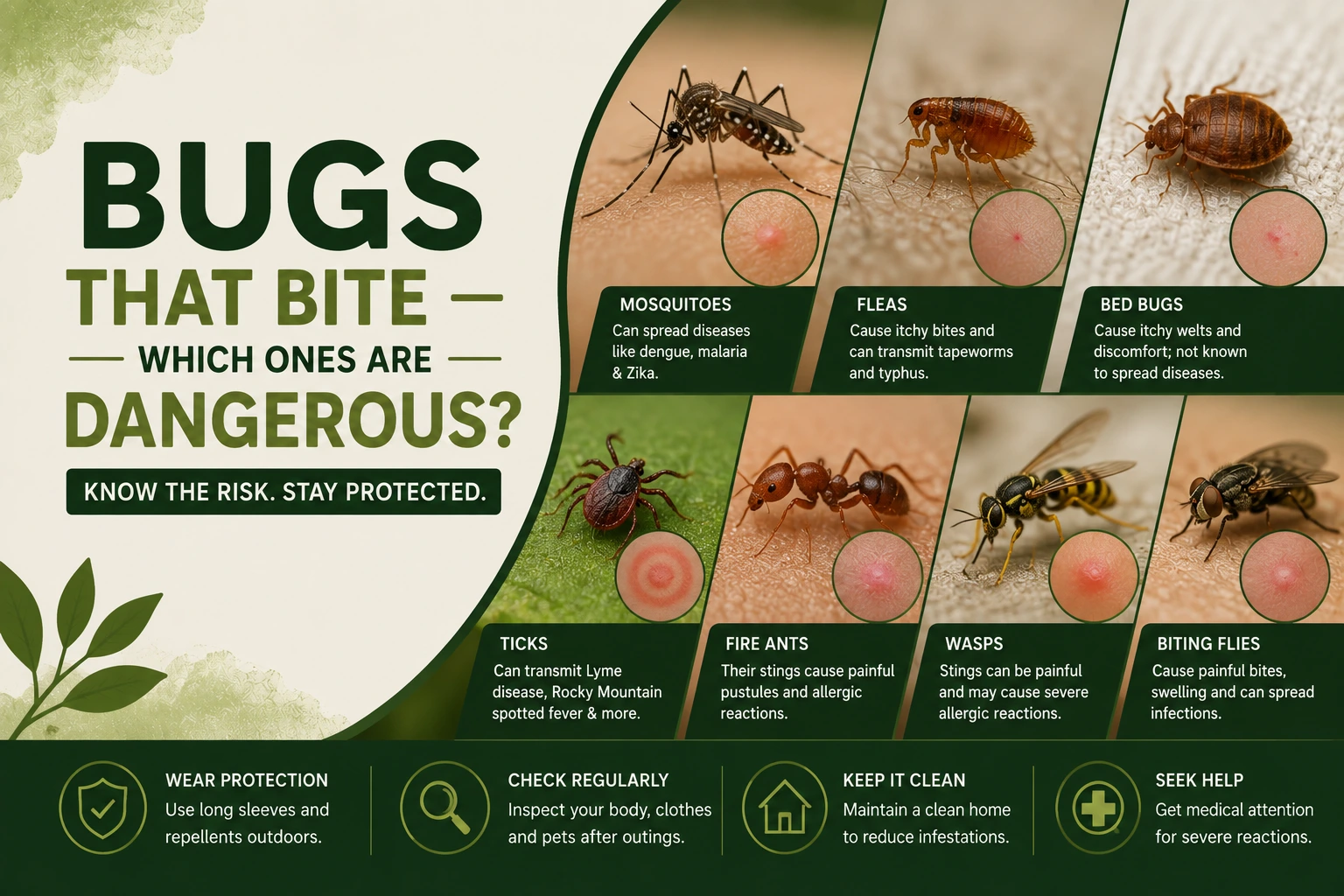
Eight species present active bite, sting, or disease transmission risks. Bed bugs, fleas, mosquitoes, ticks, brown recluses, black widows, fire ants, and kissing bugs produce distinct clinical symptoms. These dangerous bugs to avoid require specific medical responses.
A Pacific Northwest homeowner discovered a carpenter ant swarm in a damp basement at 9:00 PM in April. Winged reproductives clustered around a single window and cast a visible shadow on the wall that initially appeared as a moving stain. The homeowner sealed the window frame and scheduled a structural inspection the following morning.
The Centers for Disease Control and Prevention tracks vector-borne disease transmission from household pests. CDC arboviral surveillance reported 1,126 neuroinvasive West Nile virus cases in 2023. Lyme disease accounts for 30,000 to 40,000 reported cases annually.
Bed Bugs vs. Fleas — Bite Pattern Differences
Bed bugs leave linear 3-bite clusters on exposed arms. Flea bites concentrate on ankles in random clusters of 2 to 5 mm wheals. Mosquito bites raise 5 to 10 mm papules within 20 minutes.
Medically Significant Spiders
Black widow females display a red hourglass marking and deliver latrodectism, causing muscle cramps and diaphoresis within 1 to 3 hours. Brown recluses display a violin marking and cause loxoscelism, producing necrotic lesions within 72 hours. Do not attempt to handle or trap black widows or brown recluses without professional protective equipment. Bite symptoms require emergency medical evaluation within 4 hours.
Signs of Bug Infestation You Cannot Ignore
These signs you have a bug infestation appear before populations become visible. Frass appears as coffee grounds near cockroaches or hexagonal pellets near termites. Shed exoskeletons and egg casings accumulate in cabinet corners.
Grease trails darken baseboards. Sawdust piles beneath baseboards indicate carpenter ants and serve as structural damage indicators.
Three olfactory indicators accompany heavy infestations. Bed bugs emit a musty pheromone scent resembling coriander. Rodent-associated insects produce an ammonia odor near nests. Stink bugs release a defensive secretion through metathoracic scent glands when disturbed.
Seasonal bug problems follow predictable temperature thresholds. Termites and ants swarm in spring when soil temperatures reach 60 to 70 degrees Fahrenheit. Boxelder bugs and stink bugs invade in fall below 50 degrees Fahrenheit.
Spiders and silverfish seek winter harborage in basements. This pattern reflects seasonal pest migration into human structures.
Cockroach Infestation Signs vs. Termite Infestation Signs
German cockroaches (Blattella germanica) produce 30 to 40 eggs per ootheca, while American cockroaches (Periplaneta americana) produce 14 to 16. Cockroach frass resembles coffee grounds. Termite frass resembles hexagonal pellets.
Why Bugs Enter Homes and Where They Hide
Four primary attractants draw arthropods into the indoor ecosystem. Moisture attracts silverfish to bathrooms. Food source attraction drives ants and cockroaches to kitchens.
Warmth attracts spiders and stink bugs to wall voids. Light attracts moths to windows.
Domestic habitat conditions determine which species establish permanent populations. Specific microhabitats concentrate activity. Drain flies breed in bathroom drains.
Flour beetles colonize pantry corners. Carpenter ants establish galleries in wall voids. Bed bugs cluster in mattress seams.
Homeowners ask why do I have bugs in my house even after thorough cleaning. The myth that all house bugs indicate poor hygiene is false. Spiders enter to hunt other insects.
Silverfish consume cellulose in books. Even clean homes attract these indoor bug species. Certain indoor insect populations establish through parthenogenetic reproduction, allowing a single female to produce viable offspring without mating.
This reproductive strategy accelerates infestation growth in isolated microhabitats.
Moisture-Loving Insects in Bathrooms and Basements
Types of bugs found in bathrooms include silverfish and springtails. Silverfish require 75 to 95 percent relative humidity. Springtails indicate overwatered houseplants. Dehumidification to 30 to 50 percent relative humidity eliminates both species without chemicals.
How to Prevent Bug Infestations and When to Call an Exterminator
Bug prevention requires five exclusion steps. Seal cracks wider than 1/16 inch with silicone caulk. Install door sweeps on exterior doors.
Repair window screens with tears larger than 3 millimeters. Dehumidify to below 50 percent relative humidity. Store pantry goods in airtight glass.
Ecological pest prevention ranks above chemical intervention in the IPM hierarchy. Exclusion comes first. Sanitation comes second. Mechanical control comes third.
Chemical control comes last. IPM protocols for German cockroach infestations differ from outdoor-perimeter ant management. Indoor bait stations target the former. Exterior perimeter granules target the latter.
Professional pest removal becomes mandatory at five thresholds. Visible carpenter ant galleries require inspection. Termite mud tubes demand treatment.
Recurring bed bug activity after two DIY treatments indicates resistance. Medically significant spider presence necessitates licensed removal. Widespread German cockroach infestations exceeding 100 visible individuals per room require commercial-grade insect growth regulators.
Homeowners know when to call an exterminator upon observing these specific infestation thresholds. For more information, see professional pest control signs.
Natural Bug Repellents vs. Professional Treatments
Natural ways to repel house bugs include diatomaceous earth, which abrades the waxy cuticle of crawling insects and causes desiccation within 48 to 72 hours. Essential oils show variable efficacy in peer-reviewed studies. Pyrethroid insecticides require EPA label compliance.
Misapplication in food-prep areas violates federal regulation. Licensed applicators provide professional pest control services for whole-home chemical treatment.
Common Myth — A Clean House Means No Bugs
The myth that a clean house prevents all household arthropods is false. Spiders enter to hunt other insects. Silverfish consume cellulose in books.
Clothes moths (Tineola bisselliella) eat keratin in wool. T. bisselliella infests stored woolens in climate-controlled closets with zero food residue. Sanitation reduces cockroach and ant pressure but does not eliminate all 25 species.
Frequently Asked Questions About Common House Bugs
What are the most common house bugs?
Ants, cockroaches, spiders, silverfish, and flies rank as the most common household pests by frequency. Ants seek food residue. Cockroaches colonize moist kitchens.
Spiders hunt other insects. Silverfish require high humidity. Flies breed in organic matter. Geographic region determines local dominance.
How do I get rid of house bugs naturally?
Diatomaceous earth kills crawling insects through cuticle abrasion within 48 to 72 hours. Boric acid disrupts cockroach digestion at 1 percent concentration. Vinegar traps capture fruit flies using apple cider vinegar with dish soap. Efficacy varies by species and infestation severity.
Where do bugs hide in homes?
Wall voids, appliance motors, and mattress seams conceal the majority of indoor pest populations. Nocturnal species cluster in dark, undisturbed microhabitats during daylight hours. Bed bugs aggregate within 5 feet of the host sleeping area. Carpenter ants establish satellite colonies in water-damaged structural voids.
Are house bugs dangerous to humans?
Most species are nuisance pests. Four exceptions carry medical significance. Bed bugs cause allergic wheals.
Brown recluse bites produce necrotic loxoscelism. Black widow bites cause neurotoxic latrodectism. Kissing bugs transmit Chagas disease through Trypanosoma cruzi parasites. For additional bed bug information, see bed bug signs, symptoms, and hiding spots.
How can I tell if I have bed bugs?
Rust-colored fecal spots on mattress seams indicate active harborage. Shed skins accumulate near headboard crevices. Linear 3-bite patterns on exposed skin confirm nocturnal feeding. A flashlight inspection at 2:00 AM reveals adults migrating from seams to the host.
Conclusion
Accurate identification determines whether you manage a nuisance or a structural threat. Misidentification costs homeowners an average of $300 to $500 in unnecessary treatments while allowing destructive species like termites and carpenter ants to compound damage. For additional information about identifying household insects, see everything you need to know about bug identification.
This guide provides the morphological markers, habitat cues, and risk indicators needed to distinguish all 25 species without guesswork. Download our printable house bug identification chart and tape it inside your utility closet for instant reference during your next sighting.