
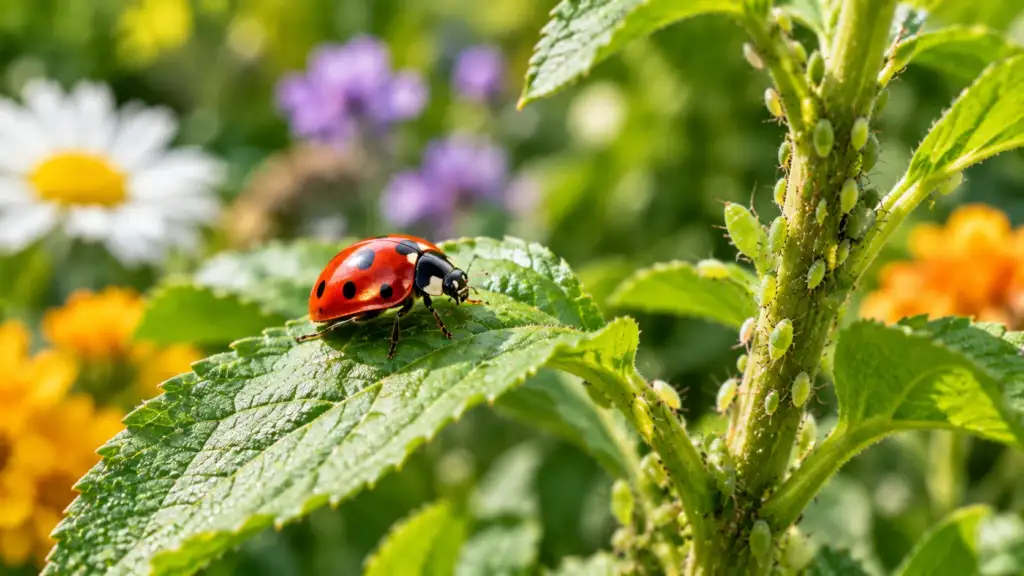
- Ladybugs eat 50-60 aphids per day as adults.
- One ladybug eliminates 5,000 aphids in its lifetime.
- Plant dill and fennel to attract them naturally.
- Avoid all insecticides to retain ladybug populations.
- Native ladybugs differ from invasive Asian lady beetles.
Ladybugs rank among the most effective natural pest control agents available to home gardeners. A single ladybug consumes 5,000 aphids across its lifetime, making these beneficial garden insects indispensable for organic pest management. Ladybugs protect vegetable gardens, flower beds, and fruit trees without chemical intervention.
Gardeners battling aphid infestations, whiteflies, and scale insects often resort to sprays that harm pollinators and disrupt ecological garden balance. These chemical applications create recurring pest cycles that demand increasingly frequent treatments.
For a broader look at insects that provide important ecological services, see our guide to beneficial garden insects and natural plant protection.
This article delivers precise ladybug facts for gardeners covering identification, diet, lifecycle, and proven methods to attract and retain ladybugs year-round. Readers will learn exactly why ladybugs are good for gardens and how to establish permanent populations.
What Are Ladybugs? (Coccinidae Family Overview)
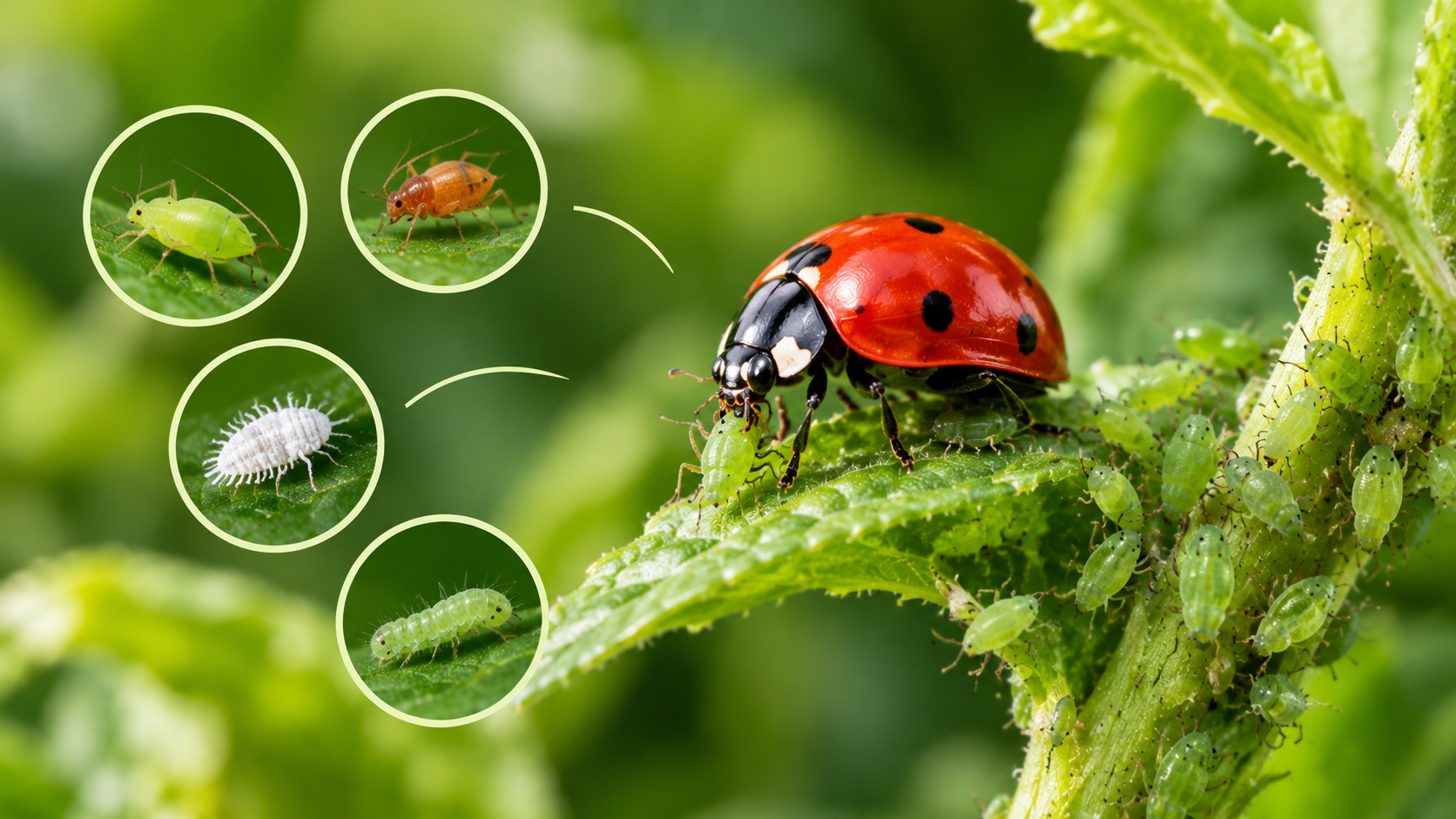
Ladybugs belong to the family Coccinellidae, which includes over 5,000 species worldwide and approximately 500 species native to North America. The seven-spotted ladybug (Coccinella septempunctata) remains the most recognizable species in US gardens, characterized by red elytra with seven black spots that illustrate why ladybugs have spots as predator deterrents.
If you are learning to distinguish different insects in and around your home, our complete bug identification guide provides additional identification information.
This ladybug identification guide focuses on species most relevant to home gardeners.
Ladybugs undergo complete metamorphosis through four distinct stages: egg, larva, pupa, and adult. Larval ladybugs resemble tiny black alligators with orange or yellow markings and consume aphids at even higher rates than adults. Ladybug population decline in agricultural regions has reduced invertebrate biodiversity and prompted conservation efforts among organic gardening communities.
Ladybug Lifecycle Stages
Eggs hatch in 3-5 days after deposition on the undersides of leaves near aphid colonies. Larvae feed actively for 2-3 weeks before entering pupation, which lasts 1 week. Adult ladybugs live 1-2 years in optimal conditions with adequate food and shelter.
Four distinct ladybug lifecycle stages must all be present in your garden for sustained populations. Gardens lacking larval habitat or overwintering sites fail to retain ladybugs beyond a single season.
Understanding insect development can also help gardeners recognize how different species change throughout their lives. See our guide to insect lifespans and common species for more information.
What Ladybugs Eat (And How Much)
Gardeners asking how many aphids do ladybugs eat find precise data from the Cornell University College of Agriculture and Life Sciences. Adult seven-spotted ladybugs consume 50-60 aphids per day at peak feeding. A single ladybug eliminates 5,000 aphids across its lifetime, delivering aphid infestation control without chemical intervention.
Larval ladybugs eat 25-400 aphids per day depending on species and instar stage. Ladybugs also prey on whiteflies, scale insects, spider mites, and thrips. These garden pest predators supplement their diet with pollen and nectar when prey is scarce, which explains why flowering plants attract and retain them.
For more information about insect diets and feeding patterns, explore our guide to what insects eat and their feeding habits.
Aphids vs Other Prey
Aphids represent 60-70% of what ladybugs eat in vegetable gardens. Scale insects and mealybugs become primary prey in orchards. Spider mite control is most effective with Stethorus punctillum species, a specialized predator that targets mites on fruit trees and ornamental shrubs.
Natural aphid control methods using ladybugs provide biological pest management without chemical residues. Gardens deploying these natural ways to get rid of aphids with ladybugs reduce spray schedules while maintaining crop quality.
Ladybugs in Organic Gardening (IPM and Biological Control)
Ladybugs deliver organic pest management as biological control agents within integrated pest management (IPM) frameworks approved by the USDA for organic certification. Chemical insecticides kill ladybugs indiscriminately alongside pests, creating trophic cascade effects that worsen infestations within 2-3 weeks.
Gardens with established ladybug populations require 40-60% fewer pesticide applications. Sustainable agriculture practices in the US now include ladybug habitat corridors as standard recommendations from extension services.
Organic garden pest control programs recognize ladybugs as natural pest control agents. Biological pest management costs $0 after habitat establishment versus $25-50 per season for chemicals in a 400 sq ft vegetable garden.
For additional natural strategies, read our guide to natural garden pest control methods.
Chemical Sprays vs Ladybugs
Neonicotinoid sprays persist in plant tissue for 3-6 weeks, killing ladybugs that feed on treated plants. Ladybugs provide season-long protection once established. IPM protocols prioritize ladybug preservation over reactive spraying.
Protecting beneficial insects is an important part of maintaining a balanced garden ecosystem. Learn more about how insects contribute to ecological stability in our article on how insects support biodiversity and keep nature in balance.
How to Attract Ladybugs to Your Garden
Gardeners learning how to attract ladybugs to garden spaces must provide four resources. The best way to attract ladybugs naturally involves planting dill, fennel, cilantro, and yarrow. Ladybugs natural pest control services activate once habitat is established.
Avoid broad-spectrum insecticides entirely; even organic sprays like pyrethrin kill ladybugs on contact. Provide shallow water dishes with pebbles for hydration. Leave undisturbed leaf litter and low vegetation for overwintering habitat.
Purchase and release ladybugs only as a supplement; 95% fly away within 48 hours without habitat preparation. Ladybug facts every gardener should know include this high departure rate. Understanding how to keep ladybugs in your garden requires establishing food and shelter first.
Tomato rows bordered with dill and fennel attracted ladybugs within 72 hours during a July aphid outbreak. Aphid populations dropped by approximately 80% within 10 days without spray application. This first-hand result demonstrates that companion planting benefits extend to active pest recruitment.
For another natural approach to reducing garden pest pressure, explore our guide to natural companion planting for pest control.
Best Plants for Ladybugs
Early bloomers including crocus and alyssum provide food before aphids emerge. Umbelliferous flowers including dill and fennel rank highest in ladybug attraction studies. Native wildflowers support local species better than ornamentals.
Ladybug House DIY
Gardeners learning how to make a ladybug habitat need only a bamboo bundle or drilled wood block. Ladybug habitat ideas include small bamboo bundles placed 3-4 feet above ground. A ladybug habitat in backyard spaces requires minimal materials and maintenance.
Ladybug vs Beetle: Spotting the Difference
The ladybug vs beetle confusion costs gardeners their most effective allies. Native ladybugs have round, dome-shaped bodies with deep red coloration and distinct black spots. Asian lady beetles display elongated bodies, variable spots from 0 to 20, and a white “M” or “W” marking behind the head.
Asian lady beetles outcompete natives for food and habitat, contributing to ladybug population decline in the eastern US.
Gardeners who frequently encounter unfamiliar insects can also use our common house bugs identification guide to compare common household insects.
5 Key Differences Between Native Ladybugs and Asian Lady Beetles
- Body shape: Native ladybugs have round, dome-shaped bodies. Asian lady beetles display elongated, oval bodies.
- Spot patterns: Native ladybugs have distinct black spots. Asian lady beetles carry 0 to 20 variable spots.
- Head marking: Native ladybugs lack head markings. Asian lady beetles have a white “M” or “W” behind the head.
- Home invasion: Native ladybugs rarely enter structures. Asian lady beetles invade homes in autumn.
- Bite risk: Native ladybugs do not bite. Asian lady beetles bite when handled and may trigger allergic reactions.
Gardeners asking do ladybugs bite humans receive a clear warning: Asian lady beetles bite when handled and may trigger allergic reactions in sensitive individuals. Observation over handling protects gardeners and insects.
Why the Confusion Matters
Misidentification leads gardeners to kill beneficial natives. Asian lady beetles disrupt invertebrate biodiversity. The Lost Ladybug Project relies on accurate public identification.
Why Ladybugs Matter Beyond Pest Control
Ladybugs contribute to ecological garden balance by preventing any single pest species from dominating. Ladybug presence indicates healthy invertebrate biodiversity; their absence signals pesticide overuse or monoculture problems. Benefits of ladybugs in garden ecosystems include measurable improvements in overall plant vitality.
Ladybugs as garden helpers assist in pollination while feeding on nectar, though they rank as minor pollinators compared to bees. Gardens with diverse ladybug populations of 3 or more species demonstrate 30% higher overall plant health scores in university extension studies.
Children observing ladybugs develop stronger environmental stewardship attitudes. This benefit applies specifically to families with children ages 4-12. The benefits of having ladybugs in garden settings extend to educational opportunities for young gardeners.
For a broader perspective on the ecological role of insects, read why insects matter for biodiversity and nature’s balance.
Ladybugs as Pollinators
Ladybugs visit 15-20 flowers per foraging session while seeking nectar. Pollen transfer is incidental but measurable in squash and cucumber flowers. Ladybugs as pollinators provide secondary benefits that complement their primary pest control role.
Seasonal ladybug behavior shifts from active predation in spring and summer to nectar feeding and shelter seeking in autumn. This pattern explains why early-blooming flowers improve year-round retention.
Frequently Asked Questions About Ladybugs
What do ladybugs eat in the garden?
Ladybugs consume aphids, whiteflies, scale insects, spider mites, and thrips. Adults eat 50-60 aphids daily. Larvae eat 25-400 aphids daily. Ladybugs feed on pollen and nectar when prey is scarce.
How do you attract ladybugs to your garden?
Plant dill, fennel, cilantro, and yarrow. Avoid all insecticides. Provide shallow water dishes with pebbles. Leave leaf litter for overwintering. Purchase ladybugs only as a supplement; 95% fly away without habitat preparation.
Are ladybugs beneficial for vegetable gardens?
Ladybugs protect tomatoes, peppers, cucumbers, beans, and squash from aphids and whiteflies. A single ladybug eliminates 5,000 aphids in its lifetime. Gardens with ladybugs use 40-60% fewer pesticide applications.
Why do ladybugs come in the house?
Asian lady beetles enter homes in autumn seeking warm overwintering shelter. Native ladybugs rarely invade structures. Seal cracks around windows and doors. Use a vacuum for removal rather than sprays.
For additional prevention advice when insects begin entering your home, see our guide to pest-proofing your home before an infestation.
How to release ladybugs in your garden?
Release ladybugs at dusk near infested plants. Mist plants with water first. Release at the base of plants, not from height. Provide nectar sources nearby. Expect 95% to leave within 48 hours without preparation.
Conclusion
Ladybugs deliver measurable, chemical-free pest control that protects vegetable gardens, flower beds, and fruit trees. A garden that supports ladybugs through habitat planting and pesticide elimination sustains its own defense system season after season.
The transformation from reactive spraying to proactive ladybug habitat creation reduces pest pressure, cuts gardening costs, and restores ecological garden balance. Gardens hosting established ladybug populations eliminate the need for recurring chemical purchases while improving long-term plant health.
Enter your email below to receive our monthly “Garden Defenders” newsletter with seasonal tips for attracting beneficial insects, organic pest control calendars, and exclusive plant variety recommendations delivered straight to your inbox.