
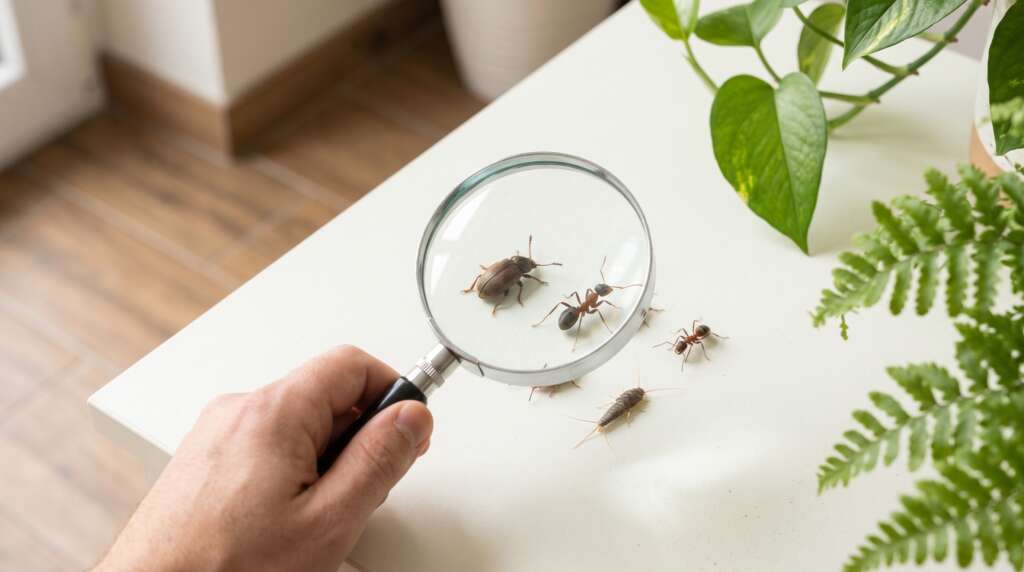
- Observe the insect’s body shape, color, leg count, and antennae structure.
- Note the room where you found it: kitchens attract pantry pests; bathrooms attract moisture-loving insects.
- Compare your observation to a visual identification chart before taking action.
- Contact a licensed professional if you observe multiple specimens, shed skins, or frass within 72 hours.
Introduction
Household insect identification relies on four observable traits: body shape, color pattern, number of legs, and the room where the specimen was found. Most common household bugs in US homes fall into six categories: ants, beetles, flies, silverfish, spiders, and occasional invaders like stink bugs. A systematic observation process eliminates guesswork and prevents the misidentification that leads to unnecessary chemical treatment.
Finding an unfamiliar insect triggers immediate uncertainty about whether it poses a health risk, damages property, or signals a hidden infestation. This pest identification guide provides a room-based identification system, visual comparison logic, and clear action steps for every common bug found in US homes.
What Kind of Bug Is This? A 4-Step Visual Identification Framework
Understanding how to identify bugs starts with a simple 4-step observation process.
- Step 1: Count the legs. Six legs indicate an insect. Eight legs indicate an arachnid. More than 8 legs indicates a centipede or millipede.
- Step 2: Note the body shape. Elongated bodies with a narrow waist suggest ants or wasps. Flattened oval shapes suggest cockroaches or bed bugs. Round and hard-shelled bodies suggest beetles.
- Step 3: Record the color and pattern. Solid black, reddish-brown, banded, spotted, or metallic sheen each narrow the identification field.
- Step 4: Document the location and time. Kitchens attract pantry pests. Bathrooms attract moisture-dependent species. Basements attract ground-dwelling arthropods. Nighttime activity suggests nocturnal species.
Mastering everything you need to know about bug identification improves when you compare live specimens to a visual reference. Bug identification by picture works best when the photo captures the dorsal view, approximate size, and the surface where the insect was found.
During a routine basement inspection in July, I observed a house centipede with 15 leg pairs traverse a 12-inch floor tile in under 2 seconds. The specimen retreated into a floor drain within 3 seconds of light exposure. This speed and photophobic behavior distinguishes house centipedes from slower-moving millipedes.
Common Household Bugs: A Room-by-Room Breakdown

Common bugs in house environments cluster by room based on food, moisture, and shelter availability. Taking time to meet common crawling insects around you helps you recognize that indoor populations follow predictable patterns once you know what each room provides.
Bug in Kitchen
Kitchen insects exploit food sources and moisture. Fruit flies are 3mm with red eyes and hover near produce. Pantry moth larvae are 12mm creamy-white instars that spin webbing in flour. Cockroaches are flattened oval, 13 to 50mm, with long antennae, and are active at night. Cockroaches are hemimetabolous insects; learning about distinct cockroach types, identification, and hiding spots helps determine if you are dealing with an American cockroach vs. German cockroach. Small black bugs in kitchen corners are often fruit flies or drain flies attracted to organic residue.
Bug in Bathroom
Bathroom insects require high humidity or standing water. Silverfish have a teardrop shape, measure 13 to 25mm, have 3 tail-like appendages, and damage paper. Drain flies have a fuzzy moth-like appearance, measure 1.5 to 5mm, and breed in pipe biofilm. Tiny black bugs in bathroom sinks are usually drain flies or springtails.
Bedroom and Closet Pests
Bedroom insects often target human hosts or textiles. Bed bugs are rust-colored, 5 to 7mm, oval, flattened, and hide in mattress seams. Recognizing bed bug signs, symptoms, and hiding spots is critical: they closely resemble an apple seed in shape and size. Carpet beetles are 2 to 5mm, round, and have patterned elytra with larval shedding on fabrics. Spiders have 8 legs and use chelicerae to grasp prey; check our house spider identification guide to separate harmless web-builders from concerning species.
Basement and Garage Invaders
Basement insects enter from soil-level entry points. House centipedes have 15 leg pairs, measure 25 to 50mm, and are fast-moving. Brown marmorated stink bugs are shield-shaped, 17mm, mottled brown, with a pronotum that has white bands. Asian needle ants are 4 to 5mm, dark brown to black, with a single-node petiole. Carpenter bee holes are perfectly round 10mm entrance holes in exposed wood.
Living Room Occasional Invaders
Living room insects are typically occasional invaders from exterior walls. Flying bugs in house living rooms may be flying ants or termite swarmers. Flying ants versus termite swarmers differ in waist constriction and wing length. Brown bugs in house living rooms during fall are often brown marmorated stink bugs seeking overwintering shelter. Many of these belong to the broader group of crawling insects and home hidden pests that find refuge behind furniture and floorboards.
Insect exoskeleton characteristics vary by room. Larval breeding sites in kitchens include flour bins and grain containers. Bathrooms sustain populations through pipe biofilm and damp grout.
Bugs That Look Like Termites: 5 Costly Misidentifications
Bugs that look like termites cause homeowners to delay correct treatment or apply the wrong products. Signs of termite damage differ from other wood-destroying insects once you know what kind of bug you are facing.
| Feature | Termite | Carpenter Ant | Powderpost Beetle |
| Waist | Broad, no constriction | Narrow, pinched | Not visible (compact body) |
| Antennae | Straight, bead-like | Elbowed | Clubbed |
| Wings (if present) | Equal length pairs | Front longer than hind | Hardened elytra cover wings |
| Wood Damage Pattern | Mud tubes, hollow galleries | Clean galleries with frass piles | Fine powder in round exit holes |
| Body Color | Creamy white to dark brown | Black, red, or brown | Dark brown to black |
Knowing proper carpenter ant identification and signs helps prevent confusion: carpenter ants have a pinched waist and elbowed antennae, while termites have a broad waist and straight bead-like antennae. Flying ants have front wings longer than hind wings. Termite swarmers have two pairs of equal-length wings. Powderpost beetles leave fine wood powder in exit holes; termites leave mud tubes.
Mayflies and midges swarm near light but lack the termite’s thick waist and straight antennae. Maggots in decaying wood are legless and soft-bodied. Termite workers have six legs and a hardened head capsule. Differentiating structural pests from beneficial garden insects and natural plant protection matters because termites cause severe structural damage, whereas carpenter ants excavate existing wood but do not consume it.
Signs of Infestation: When One Bug Signals Hundreds More
Signs of infestation extend beyond the single specimen you found:
- Shed skins or exoskeletons in concentrated areas indicate active molting and population growth.
- Frass near baseboards, window sills, or pantry shelves signals sustained activity.
- Egg casings (oothecae for cockroaches, 5 to 13mm, tan to dark brown) contain 10 to 50 eggs each.
- Nighttime rustling in wall voids or cabinet spaces suggests nocturnal colony movement.
- Multiple specimens of the same species found within a 7-day window indicates establishment, not accidental entry.
Knowing how to tell if you have an infestation starts with these five indicators. Finding a bug repeatedly means the species has found food, water, or shelter inside. The National Pest Management Association reports that termites cause approximately $5 billion in property damage annually in the United States, underscoring the financial risk of ignoring early infestation indicators.
How to Get Rid of Household Insects: Safe Treatment Methods
Getting rid of unwanted insects begins with non-chemical methods before escalating to products:
- Step 1: Physical removal with a vacuum and sealed disposal bag eliminates single specimens without chemicals.
- Step 2: Diatomaceous earth (food-grade) applied as a 2mm dust line along baseboards desiccates crawling insects within 48 hours.
- Step 3: Boric acid bait stations placed 12 inches apart target ant trails and cockroach aggregation points (review proven cockroach prevention tips for optimal placement).
- Step 4: Pheromone traps capture pantry moth adults and interrupt the breeding cycle.
- Step 5: Sticky traps placed near suspected entry points monitor population levels and confirm elimination.
What to do if you find multiple bugs requires matching the treatment to the species. DIY insecticide treatments work effectively for single-occurrence sightings of non-venomous insects in homes without children under 3 years old, pregnant individuals, or pets with respiratory conditions. The EPA recommends reading the entire product label before applying any pesticide indoors. Improper application of pyrethroid sprays in enclosed spaces has been linked to respiratory irritation in sensitive individuals.
Long-term management focuses on proactive exclusion. Learn how to pest-proof your home before an infestation starts through proper sanitation and sealing. Moisture control indoors with dehumidifiers set to 50% relative humidity dramatically reduces silverfish and drain fly populations.
When Professional Pest Control Becomes Necessary
Professional pest control becomes necessary when DIY methods fail or safety risks escalate. Reviewing the clear signs you need professional pest control helps avoid unnecessary delays:
- Contact a licensed professional if you observe more than 5 specimens of the same species within 72 hours.
- Structural pests (termites, carpenter ants, carpenter bees) require professional inspection because colony locations are often concealed.
- Venomous species (black widow spiders, brown recluse spiders) in homes with children or immunocompromised individuals warrant immediate professional response.
Integrated pest management programs include inspection, species identification, treatment, exclusion sealing, and follow-up monitoring. A qualified pest control operator holds state licensure and provides a written treatment plan with warranty terms. Homeowners in multi-unit buildings or structures built before 1980 face higher infestation risk due to settled foundations and unsealed utility penetrations, benefiting from annual professional inspections regardless of visible insect activity.
Frequently Asked Questions About Household Bug Identification
What kind of bug is this?
Identify the insect by checking four traits: leg count (6 for insects, 8 for spiders), body shape (oval, elongated, or round), color pattern, and the room where you found it. Kitchens attract pantry pests; bathrooms attract moisture-loving species. Match your observations to our visual guides on The Crawlix Blog before deciding on treatment.
How do I identify insects in my house?
Start with a flashlight inspection. Look for antennae shape, wing structure, and movement speed. Ants have elbowed antennae and a narrow waist. Beetles have hard wing covers. Silverfish have three tail appendages. Note the exact location and time of day. Photograph the specimen for comparison with university extension databases.
Why are there bugs in my bathroom?
Bathrooms provide the high humidity and standing water that silverfish, drain flies, and springtails require for survival. Leaky pipes, damp grout, and condensation on toilet tanks create ideal breeding conditions. Reducing moisture with a dehumidifier set to 50% relative humidity and fixing leaks eliminates the environment that sustains these populations.
Do house centipedes bite?
House centipedes possess venomous front legs called forcipules that can penetrate human skin, but bites are rare and occur only when the insect is trapped against the body. Bites cause localized pain similar to a bee sting, with redness subsiding within 48 hours. House centipedes are not medically dangerous to humans.
What are the tiny bugs in my kitchen?
Tiny kitchen bugs are usually fruit flies (3mm, red eyes, near produce), drain flies (1.5 to 5mm, fuzzy, near sinks), or pantry moth larvae (12mm, creamy white, in flour or grains). Each requires a different treatment: fruit flies need produce removal, drain flies need pipe cleaning, and pantry moths require discarding infested food and freezing new grains for 72 hours.
Conclusion
Accurate household insect identification depends on systematic observation of physical traits and location, not panic. Most mystery bugs in US homes are harmless occasional invaders that respond to simple environmental corrections.
Readers who follow the 4-step framework avoid unnecessary chemical exposure, save money on misdirected treatments, and know exactly when professional intervention is justified.
If you have identified signs of infestation or found a bug you cannot classify, schedule a free inspection with our licensed technicians and receive a written treatment plan within 24 hours.